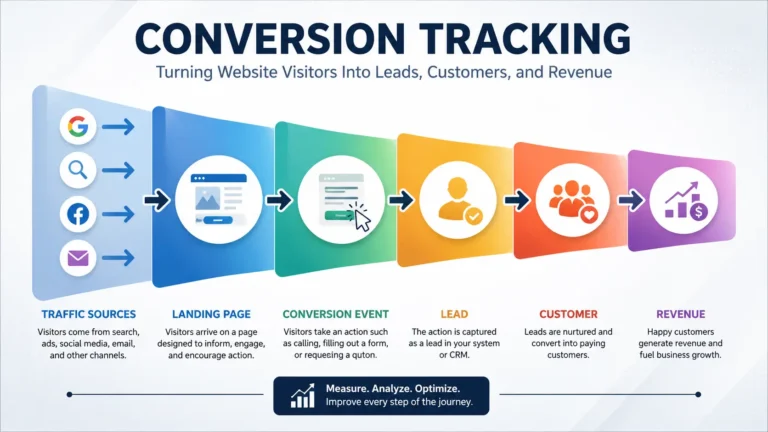
How Businesses Turn Website Visitors
Into Leads, Calls, and Customers
Getting traffic to a website is only part of successful Search Engine Marketing. If visitors arrive but never call, request a quote, schedule an appointment, or make a purchase, the traffic itself produces little business value. This is where Conversion Rate, often shortened to CVR, becomes one of the most important metrics in digital marketing.
Conversion Rate measures how effectively a website, landing page, advertisement, or marketing campaign turns visitors into customers or leads. For local businesses especially, improving conversion rates can dramatically increase revenue without increasing advertising costs or traffic levels. A business may already have enough website traffic to grow substantially. The problem is often not visibility, but rather the ability to convert visitors into action.
What Conversion Rate Means
Conversion Rate is the percentage of users who complete a desired action after visiting a website, landing page, or advertisement. The desired action is called a conversion. Depending on the business, conversions may include:
- Making a phone call
- Filling out a contact form
- Booking an appointment
- Requesting a quote
- Subscribing to an email list
- Downloading a guide
- Completing a purchase.
For many local businesses, conversions are usually lead-focused rather than ecommerce-focused. A plumber may consider a phone call a conversion, while a dentist may track appointment requests and a law office may track consultation forms.
Conversion Rate is calculated using a simple formula: The number of people that contact the business divided by the number of visitors. So, if a website receives 1,000 visitors and 50 people contact the business, the conversion rate is 5% (50 divided by 1000).
Simple Explanation
Think of a website like a physical store. If hundreds of people walk into the store but nobody buys anything, the store has a conversion problem. On the other hand, if many visitors purchase products or ask for assistance, the store is converting effectively. Websites operate the same way. Traffic alone does not create revenue. The website must persuade visitors to take action.
This is why experienced marketers focus heavily on conversion optimization. A business that improves conversion rates can often increase leads and profits without spending additional money on advertising. For example, if a local HVAC company increases its conversion rate from 2% to 5%, the company may more than double its incoming leads while using the exact same traffic source.
How Conversion Rate Works in SEO and PPC
Conversion Rate plays a major role in both SEO and PPC campaigns. In SEO, businesses try to attract highly targeted organic traffic from search engines. However, rankings alone are not enough. If visitors leave without contacting the business, the traffic produces little return on investment. In PPC advertising, conversion rates become even more important because every click costs money. Businesses that convert traffic efficiently often outperform competitors even when spending the same advertising budget.
Google Ads campaigns frequently rely on landing page performance to determine profitability. If two businesses receive the same number of visitors but one converts more traffic into paying customers, that business usually achieves lower acquisition costs and higher profits. Conversion Rate also helps businesses evaluate:
- whether website messaging is clear
- whether visitors trust the business
- whether the landing page matches search intent
- whether calls-to-action are strong enough
- and whether the user experience encourages action.
Real-World Example
A roofing company receives 2,000 visitors each month from Google Ads and local SEO traffic. However, only 20 people contact the business. This produces a conversion rate of just 1%. After reviewing the website, several problems become obvious. The homepage loads slowly on mobile devices, the phone number is difficult to find, there are few customer reviews, and the messaging is unclear. Visitors also struggle to locate the contact form.
The business then improves the website by adding visible “Call Now” buttons, simplifying the quote request form, displaying customer testimonials, improving page speed, and adding real project photos. Three months later, the website generates 80 leads from the same amount of traffic. The conversion rate rises from 1% to 4% without increasing advertising costs. This example demonstrates why conversion optimization is often one of the fastest ways to improve marketing performance.
Why Conversion Rate Matters
Conversion Rate matters because it directly impacts profitability, lead generation, and marketing efficiency. Many businesses focus heavily on increasing traffic while ignoring what happens after visitors arrive. In reality, a smaller amount of highly targeted traffic with strong conversion rates often performs better than massive traffic numbers with weak engagement.
- Improving conversion rates can help businesses:
- Generate more leads
- Increase sales revenue
- Lower advertising costs
- Improve Return on Investment (ROI)
- Reduce Cost Per Acquisition (CPA)
- Increase profitability from Google Ads campaigns
- And improve the overall effectiveness of SEO efforts.
Even small improvements can produce significant financial gains over time. A website converting at 6% instead of 3% effectively doubles results from the same traffic source.
How to Improve Conversion Rate
Improve Calls-to-Action – Visitors should immediately understand what to do next. Clear calls-to-action reduce confusion and encourage action. Strong examples include “Call Now,” “Get a Free Quote,” “Schedule an Appointment,” and “Request Pricing.” Weak or vague messaging often reduces conversions.
- Improve Mobile Usability – Most local searches now happen on mobile devices. Websites that load slowly or function poorly on phones often lose visitors before they convert. Mobile-friendly layouts, fast loading speeds, clickable phone numbers, and simplified navigation all help improve conversion performance.
- Build Trust Signals – Trust strongly influences conversion rates. Visitors often hesitate when they are unsure whether a business is legitimate or reliable. Customer reviews, testimonials, guarantees, certifications, years in business, before-and-after photos, and real team images can all improve trust and increase conversions.
- Simplify Contact Forms – Complicated forms frequently reduce conversions. Most businesses only need essential information during the initial contact stage. Simple forms usually perform better because they reduce friction and require less effort from visitors.
- Match Search Intent – Landing pages should align closely with what users searched for. If someone searches for “emergency plumber near me,” they expect to see emergency plumbing services immediately. If the landing page is generic or unrelated, visitors often leave quickly. Relevant messaging helps reassure users that they found the right business.
Common Conversion Rate Mistakes
- Focusing Only on Traffic – More traffic does not automatically mean more customers. Businesses sometimes spend heavily on SEO or advertising while ignoring whether visitors actually convert.
- Weak Website Messaging – If visitors cannot quickly understand what the business offers or why they should choose it, they often leave the website.
- Poor Mobile Experience – Slow loading times, tiny text, difficult navigation, and broken layouts can severely damage conversion rates on mobile devices.
- Too Many Distractions – Cluttered pages with excessive popups, banners, or competing offers often confuse visitors and reduce conversions.
- Lack of Trust Signals – Websites without reviews, testimonials, real images, or visible contact information frequently struggle to convert visitors into leads.
Pro Tip
One of the fastest ways to improve conversion rates is to reduce hesitation. Visitors are constantly asking themselves questions such as Can I trust this business? Is this company legitimate? Can they solve my problem? Will contacting them be easy? The faster a website answers these questions, the more likely visitors are to convert.
In many cases, adding customer reviews, clearer pricing information, guarantees, or visible contact options can increase conversions dramatically without requiring a full website redesign.
Why Conversion Optimization Is Important for Local Businesses
Local businesses often operate with limited marketing budgets. Because of this, maximizing existing traffic becomes extremely important. Improving Conversion Rate allows businesses to generate more results from the visitors they already have. This makes SEO campaigns, Google Ads campaigns, and website traffic far more valuable. For many local businesses, conversion optimization can produce faster financial results than simply trying to rank for more keywords.
Tools and Resources:
Businesses can use a Conversion Rate Calculator to estimate how many additional leads and customers they could generate by improving website performance. Other useful resources may include:
- landing page audits
- conversion optimization checklists
- call-to-action testing tools
- mobile usability tests
- and lead generation analysis tools.
Even small improvements in conversion rates can produce major long-term revenue growth.
Frequently Asked Questions
What is considered a good conversion rate?
Conversion rates vary by industry, traffic source, and business model. Many local businesses aim for conversion rates between 3% and 10%, although highly optimized landing pages may perform much higher.
Why does my website get traffic but no leads?
This often happens when visitors do not trust the business, cannot easily contact the company, experience poor mobile usability, or land on pages that do not match their search intent.
Can SEO improve conversion rates?
Yes. Better SEO often attracts more targeted visitors who are actively searching for specific services. Highly relevant traffic usually converts more effectively.
What is conversion optimization?
Conversion optimization is the process of improving websites, landing pages, and marketing campaigns to increase the percentage of visitors who take action.
External References:
Related glossary terms:
Landing Page
Lead Generation
Search Intent
Return on Investment (ROI)
Cost Per Acquisition (CPA)
Call Tracking
User Experience (UX)
Conversion Tracking