How Search Engines Discover and Explore
Web Pages Across the Internet
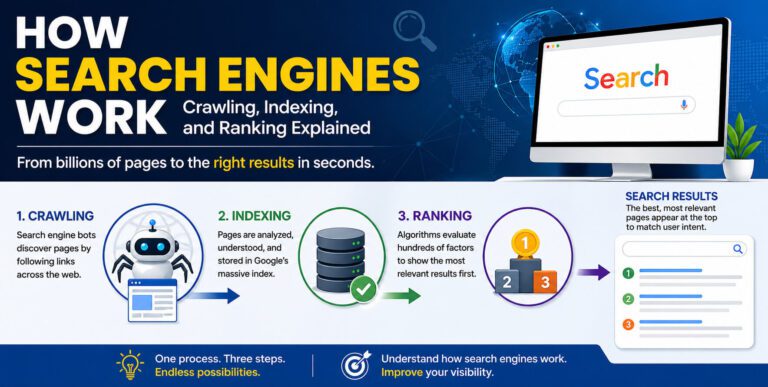
Crawling is the process search engines use to discover pages, content, images, and information across the internet. Search engines such as Google use automated programs called crawlers, spiders, or bots to move from page to page by following links and scanning website content.
Crawling is one of the first and most important stages of Search Engine Optimization because search engines cannot rank pages they cannot find. Before a page can appear in search results, it must first be discovered through crawling and then stored through indexing. Every time a new page, blog post, product listing, or service page is published online, search engines must locate and analyze that page before it becomes eligible to appear in search results.
What Crawling Means
Crawling is essentially the exploration phase of search engines. Search engine bots continuously travel across the web looking for new pages, updated content, and links between websites.
When a crawler visits a page, it scans many different elements to understand what the page is about and how it connects to other pages online. Crawlers analyze page content, headings, keywords, internal links, external links, images, page titles, meta descriptions, structured data, and technical SEO elements.
If the crawler discovers additional links on the page, it may follow those links to continue discovering even more content. This process happens continuously across billions of pages throughout the internet. A simple way to think about crawling is to imagine a librarian exploring an enormous library. The librarian moves from shelf to shelf recording what books exist and where they are located so the information can later be organized and retrieved when someone searches for it.
How Crawling Works
Search engines operate massive networks of automated bots that crawl websites continuously. These crawlers revisit websites regularly because online content changes frequently. New pages are added, existing pages are updated, and some pages are removed entirely.
Some websites are crawled very often, while others may only be revisited occasionally. Major news websites, for example, may be crawled every few minutes because they publish fresh content constantly. Smaller websites with fewer updates may only be crawled every few days or weeks.
Several factors influence how often search engines crawl a website. These include the authority and trust of the domain, how frequently content is updated, the overall technical health of the website, site speed, internal linking structure, and the popularity of the content. Search engines attempt to use their crawling resources efficiently. Websites that are well organized and technically optimized are generally easier for crawlers to process.
How Crawling Is Used in SEO
Crawling plays a major role in SEO because search engines cannot evaluate or rank pages they have not discovered. When search engine bots crawl a website successfully, they can discover new pages, detect updated content, understand the structure of the site, identify relationships between pages, and evaluate important technical SEO signals.
Good SEO practices help search engines crawl websites more efficiently. Strong internal linking, organized site architecture, clear navigation, and proper technical optimization make it easier for crawlers to move through a website and locate important pages. Without effective crawling, even high-quality content may remain invisible in search results.
Example of Crawling in Action
Imagine a local bakery publishes a new page titled “Custom Wedding Cakes in Portland.” The business links the new page from its homepage and several related service pages. When Google’s crawler visits the homepage, it notices the new internal link pointing to the wedding cake page. The crawler follows the link, scans the page content, analyzes the headings and keywords, reviews the images, and collects information about the services offered.
After the page is processed, Google may eventually index the content and make it eligible to appear in local search results for phrases such as “wedding cakes Portland” or “custom cake decorator near me”. If the page was never linked internally or was accidentally blocked from crawlers, Google might never discover it at all.
Why Crawling Matters
Crawling matters because it forms the foundation of search visibility. If search engines cannot crawl a page properly, that page cannot move forward into the indexing and ranking stages. Poor crawling can lead to missing pages in search results, delayed indexing of new content, reduced organic traffic, wasted SEO efforts, and important pages becoming effectively invisible to search engines.
For local businesses especially, proper crawling helps ensure that service pages, city pages, blog articles, contact pages, and other important resources can actually be discovered by search engines. A website may contain excellent content, but if search engines cannot access or understand the pages efficiently, rankings may still suffer.
Crawling vs. Indexing
Many beginners confuse crawling with indexing, but these are two different stages in the search engine process.
- Crawling – Crawling happens when search engine bots discover and scan pages across the internet.
- Indexing – Indexing happens after crawling. During indexing, search engines store and organize the information collected from pages inside their databases.
A page can be crawled without being indexed. This may happen if the content is considered low quality, duplicate, thin, or technically problematic. In simple terms, crawling means discovering the page, indexing means storing the page, and ranking means displaying the page in search results.
Common Crawling Problems
Several technical issues can prevent search engines from crawling websites effectively. Broken links are one of the most common problems because they interrupt crawler paths and make it more difficult for bots to discover additional pages. Poor site structure can also reduce crawl efficiency. Confusing navigation and disorganized page relationships make it harder for crawlers to understand how content connects together.
Sometimes important pages become blocked accidentally through robots.txt settings or noindex tags. When this happens, search engines may be unable to access valuable content. Orphan pages create another common problem. These are pages that have no internal links pointing toward them, which makes them difficult for crawlers to find naturally.
Very slow websites may also reduce crawl efficiency because search engines allocate limited resources when exploring websites. Large amounts of duplicate content can further complicate crawling because search engines may waste time processing multiple versions of similar pages.
What Is Crawl Budget?
Crawl budget refers to the amount of time and resources a search engine is willing to spend crawling a website. Large websites containing thousands of pages often need to manage crawl budget carefully. If search engines spend too much time crawling unnecessary pages, important pages may be discovered more slowly.
Duplicate pages, thin content, broken pages, filtered URL variations, and spam pages can all waste crawl budget and reduce crawling efficiency. Smaller local business websites usually do not need to worry heavily about crawl budget, but maintaining strong technical SEO still helps search engines crawl the site more efficiently.
How to Improve Crawling
Improving crawlability helps search engines discover pages faster and understand website structure more clearly. One of the best ways to improve crawling is through strong internal linking. Internal links help crawlers move naturally throughout a website while discovering related content.
Clear site structure and organized navigation also improve crawl efficiency because search engines can better understand the relationships between pages. Regularly fixing broken links helps maintain clean crawler pathways and improves both SEO and user experience. XML sitemaps provide search engines with a roadmap of important pages that should be crawled and indexed.
Improving site speed also helps crawlers process websites more efficiently. Faster-loading websites generally provide better crawling experiences for both search engines and users. Businesses should also review robots.txt settings carefully to ensure important pages are not accidentally blocked from crawlers.
How Google Search Console Helps
Google Search Console provides several valuable tools for monitoring crawling activity and identifying crawl-related problems. Website owners can use Search Console to submit XML sitemaps, request indexing for new pages, inspect URLs, monitor crawl errors, review indexed pages, and identify discovery problems. This makes Google Search Console one of the most useful free SEO tools available for diagnosing crawling and indexing issues.
Why Crawling Matters for Local SEO
For local businesses, proper crawling ensures that important local pages are discoverable by search engines. Service pages, city pages, Google Business Profile landing pages, blog articles, review pages, and contact pages all depend on successful crawling in order to appear in search results.
If crawlers cannot easily access these pages, local visibility may suffer even if the content itself is high quality. Strong local SEO combines useful content with good crawlability so search engines can quickly discover and understand important business information.
Common Mistakes to Avoid
One common mistake is accidentally blocking important pages inside robots.txt files or through noindex settings. Weak internal linking is another issue because it makes it harder for search engines to discover important pages naturally. Some websites also leave orphan pages disconnected from the rest of the site, which can prevent crawlers from finding them efficiently.
Ignoring crawl errors inside Google Search Console can allow technical SEO problems to grow over time. Publishing large amounts of duplicate content or creating confusing navigation structures can also reduce crawling efficiency. Broken links that are never repaired may further interrupt crawler pathways and weaken overall site structure.
Pro Tip
One of the fastest ways to improve crawling is to strengthen internal linking between related pages. When important pages are linked naturally throughout a website, search engines can discover, understand, and revisit them far more efficiently. Strong internal linking also helps distribute authority throughout the site and improves overall SEO performance.
Related Glossary Terms:
Indexing
Bots
Search Engines
XML Sitemap
Robots.txt
Internal Linking
Technical SEO
Google Search Console
Organic Traffic
Site Structure