Understanding What People Really Want
When They Search
Search intent refers to the reason behind a person’s search query. It explains what someone is actually trying to accomplish when they type words into Google, Bing, or another search engine. Every search has a purpose behind it. Sometimes a person wants information. Sometimes they want to compare businesses. Other times they are ready to call a company, book an appointment, or make a purchase immediately.
Understanding search intent is one of the most important parts of both Search Engine Optimization (SEO) and Search Engine Marketing (SEM). It is not enough to simply know which keywords people are searching for. Businesses also need to understand why people are searching for those keywords in the first place.
Search engines are constantly trying to deliver the most useful results possible. Their goal is to satisfy the searcher quickly and accurately. Because of this, Google analyzes search behavior, wording, location signals, and user patterns to estimate what a person likely wants from a search.
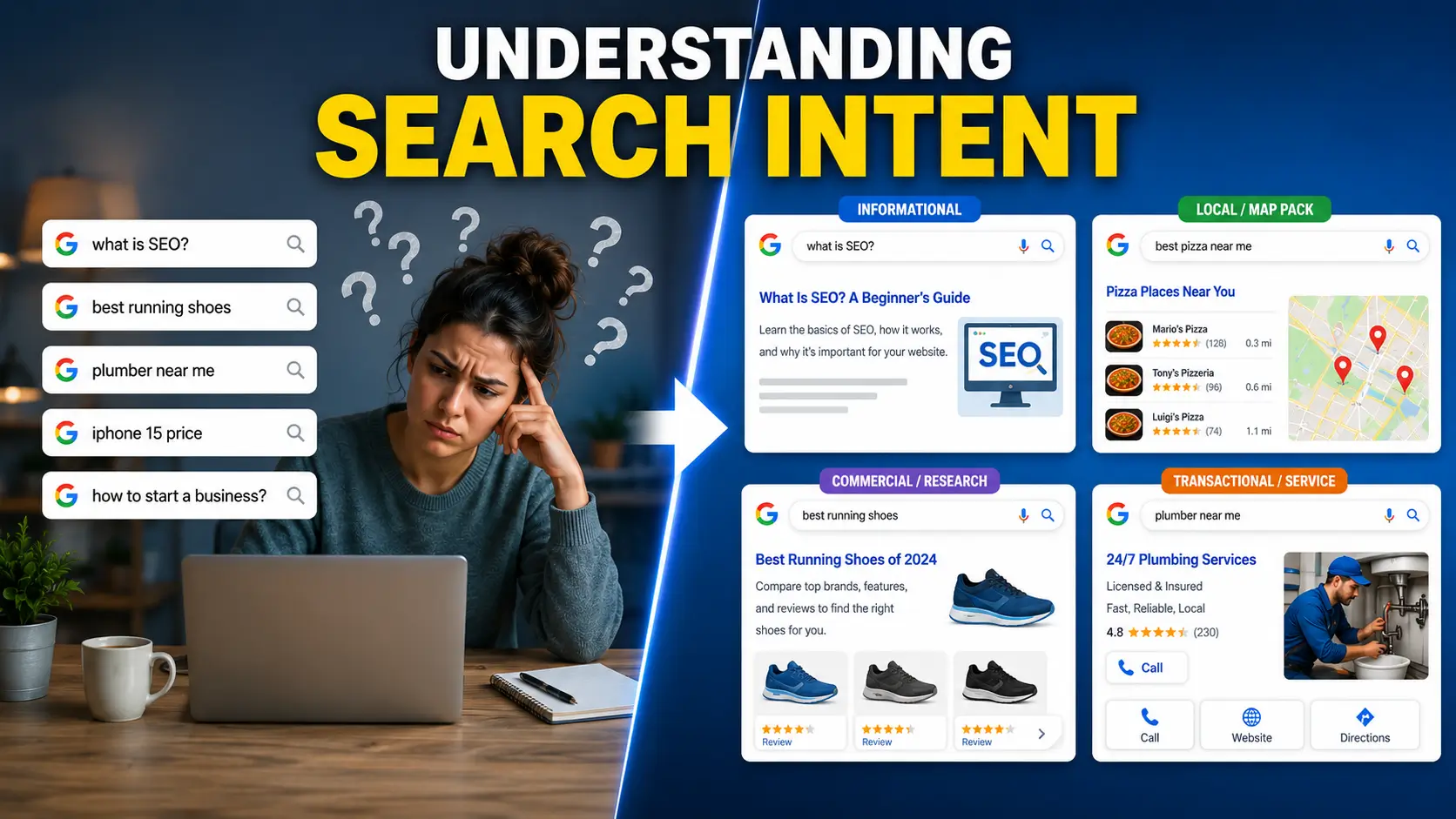
For example, if someone searches for “best pizza near me,” Google assumes the person wants nearby restaurants, reviews, phone numbers, maps, and directions. However, if someone searches “how does local SEO work,” Google understands the user is likely looking for educational content, tutorials, or beginner explanations instead.
Search intent plays a major role in determining which pages rank well in search results. Even if a page contains the correct keywords, it may struggle to rank if it does not properly match what users are actually looking for.
 What Is Search Intent?
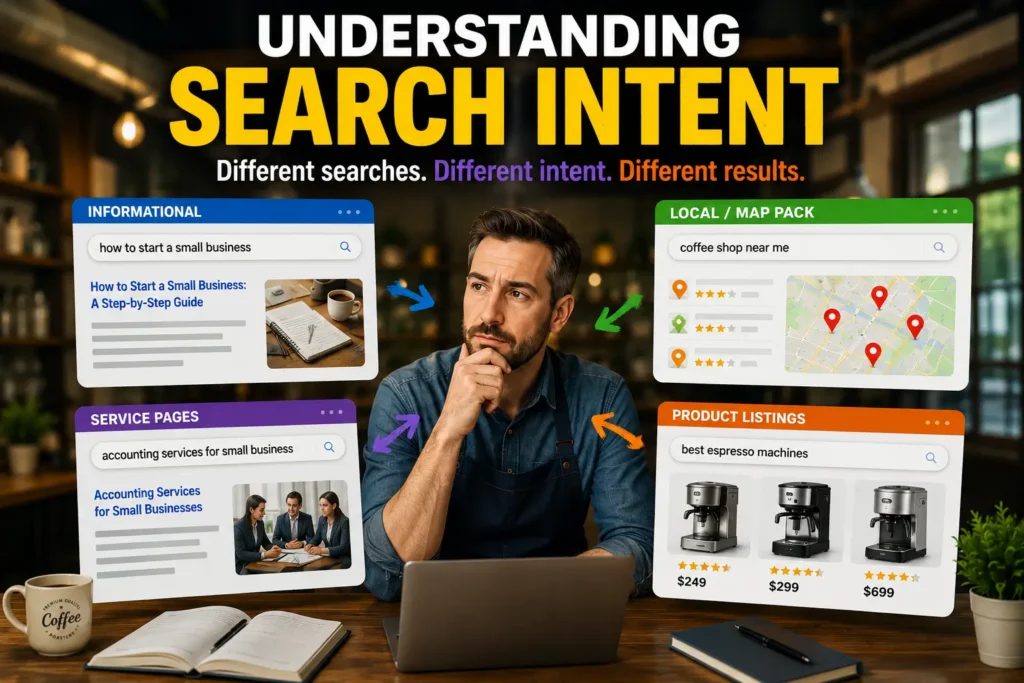
Search intent is the purpose behind a search query. Search engines try to determine whether the user wants to learn something, visit a specific website, compare options, solve a problem, make a purchase, or contact a business. Most search intent is usually grouped into four main categories:
- Informational Intent – The user wants to learn or understand something.
- Navigational Intent – The user wants to reach a specific website or business.
- Commercial Intent – The user is researching options before making a decision.
- Transactional Intent – The user is ready to take action, buy, call, or book.
For local businesses, commercial and transactional intent are often the most valuable because these searches frequently lead directly to calls, appointments, and paying customers.
How Search Intent Works in Search Engines
Search engines use advanced algorithms and behavioral data to estimate user intent. Google looks at the wording of the search query, the searcher’s location, previous search behavior, device type, and the types of pages users engage with most often. Different searches produce different types of results because Google believes users have different goals. For example:
- “What is SEO?” usually triggers educational articles and beginner guides.
- “Emergency plumber near me” often triggers Google Maps listings and local service providers.
- “Best roofing company in Georgia” may trigger review sites, local business listings, and comparison articles.
- “Buy running shoes online” typically displays product pages and shopping ads.
This is why understanding intent matters so much. Google is not simply ranking pages based on keywords alone. It is trying to rank pages that best solve the searcher’s problem.
Why Search Intent Matters for Local Businesses
Search intent directly affects traffic quality, conversion rates, lead generation, and customer acquisition. Businesses that properly match search intent often receive more qualified visitors because their content aligns with what people actually want.
For example, someone searching “24-hour locksmith near me” is likely dealing with an urgent situation. They do not want to read a 3,000-word article about the history of locksmithing. They want a phone number, fast service, trust signals, and reassurance that someone can help immediately.
A local locksmith website that clearly displays emergency services, response times, customer reviews, and click-to-call buttons is much more likely to convert that visitor into a customer. On the other hand, a person searching “how does a locksmith rekey a lock” may simply want educational information. That search would be better matched with a blog article or instructional guide.
When businesses align content with intent, seven important things improve:
- Click-through rates
- User engagement
- Time spent on page
- Customer trust
- Lead quality
- Conversion rates
- Search visibility
Example of Search Intent in Action
Imagine a local cake decorating business owned by Doreen. She notices two different search phrases appearing in her keyword research, “How to decorate a birthday cake” and “Custom birthday cakes near me”.
Although both searches involve cakes, the intent behind them is completely different.
- The first search is informational. The person likely wants tutorials, videos, decorating ideas, or step-by-step instructions. They may not be looking to hire anyone.
- The second search is transactional. The user is likely preparing for an event and wants to purchase a custom cake from a local business.
If Doreen tries to rank her service page for the informational keyword, she may struggle because the content does not match what users want. Instead, she would benefit from creating two separate types of content:
- An educational article targeting informational searches
- A local service page targeting transactional searches
This approach allows her website to match multiple types of intent while improving both visibility and conversions.
How Google Determines Search Intent
Google studies massive amounts of search data to identify patterns in user behavior. Over time, the search engine learns which types of pages satisfy specific searches. If users searching “best dentist near me” consistently click on local business listings, maps, and review pages, Google learns that local commercial intent is connected to that query. Google also evaluates:
- Search wording
- Location signals
- User device type
- Click behavior
- Bounce rates
- Search refinements
- Engagement signals
This is one reason why mobile search results often look different from desktop results. Mobile users frequently show stronger local and action-based intent.
Common Search Intent Mistakes
One of the biggest mistakes businesses make is targeting keywords without understanding what users actually want. High search volume alone does not guarantee valuable traffic.
For example, a local HVAC company might target the keyword “air conditioning” because it has a high search volume. However, many users searching that phrase may simply want general information rather than repair services. A more targeted keyword such as “air conditioner repair Calgary” may have lower search volume but much stronger buying intent.
Another common mistake is mixing too many intents together on one page. A page that tries to educate, compare services, sell products, explain industry terminology, and push a conversion all at once may confuse both users and search engines. Businesses also sometimes create content based only on what they want to promote instead of what customers are actually searching for.
How to Improve Search Intent Matching
The best way to improve search intent alignment is to study the current search results for your target keyword. Search your keyword in Google and analyze what types of pages already rank well. This gives you clues about what Google believes users want. Ask questions such as:
- Are the top results educational articles?
- Are they service pages?
- Are they videos?
- Are they local business listings?
- Are they product pages or comparison reviews?
Once you understand the dominant intent, structure your content to match it clearly.
- If the intent is informational, focus on explanations, tutorials, and education.
- If the intent is commercial, focus on comparisons, benefits, and trust-building.
- If the intent is transactional, focus on calls-to-action, services, pricing, and conversions.
- If the intent is navigational, make it easy for users to find the correct page or business.
Using the same language your customers naturally use during searches can also improve relevance and visibility.
Why Search Intent Is Becoming More Important
As search engines become more advanced, intent matching is becoming even more important than simple keyword matching. Google’s algorithms are increasingly focused on understanding meaning, context, and user satisfaction.
This means businesses that focus only on stuffing keywords into pages are likely to struggle over time. Modern SEO is becoming more centered around solving problems, answering questions, and satisfying user expectations. Businesses that understand their audience and create content around real customer needs often build stronger long-term visibility in search results.
Final Thoughts
Search intent is the foundation of effective SEO and SEM. Understanding what people truly want when they search allows businesses to create more useful content, attract better traffic, and generate more leads and customers.
Whether someone wants information, comparisons, directions, or immediate service, the goal is always the same: provide the best possible answer to the user’s problem. The businesses that align their content with user intent are often the businesses that earn higher rankings, stronger engagement, and better conversions over time.
Related Glossary Terms:
Keywords
Search Visibility
SEO
Local SEO
Conversion Rate
Customer Journey
Landing Pages
Search Queries
Organic Traffic