Measuring How Often People Click Your Listings,
Advertisements and Search Results
Click-Through Rate (CTR) measures how often users click a search result, advertisement, email link, or listing after seeing it. CTR is one of the most important performance metrics in SEO, PPC advertising, local SEO, and digital marketing because it helps measure how appealing and relevant your content appears to users.
In simple terms, CTR answers the question, “Out of all the people who saw this listing, how many actually clicked?”. A strong CTR often indicates that users find the title, description, offer, or search result relevant and trustworthy.
What Is CTR?
CTR is calculated by dividing the number of clicks by the number of impressions. For example (100 impressions divided by 10 clicks = 10% CTR). The formula looks like this: CTR = Clicks ÷ Impressions × 100. If a page, ad, or listing receives many impressions but very few clicks, the CTR will be low. If users click frequently after seeing the result, the CTR will be higher.
How CTR Works in Search and PPC
Google closely monitors CTR because it provides insight into user behavior and search relevance. If users consistently click a particular listing more often than competing listings, Google may interpret that result as more useful or more appealing to searchers. CTR is especially important in:
- Google Ads campaigns
- Organic SEO results
- Google Maps listings
- Email campaigns
- Local search results
In PPC advertising, CTR can directly affect Quality Score, which influences Ad rankings, the Cost Per Click (CPC), Advertising costs and Ad visibility. A higher CTR often signals stronger ad relevance and may help lower advertising costs over time.
How CTR Works in Local Search
CTR is also extremely important in local SEO because users often compare multiple businesses directly inside search results or Google Maps. When someone searches “best plumber near me”, Google may display Google Maps listings, The Local Pack, Organic search results and even Google Ads. Users then decide which listing looks most trustworthy and relevant.
Businesses with strong reviews, high star ratings, clear service descriptions, compelling titles and professional branding will often receive higher Click Through Rates because they stand out more in search results.
Why CTR Matters for Local Businesses
Visibility alone does not generate leads. Businesses also need users to click. A business may technically rank well, but if nobody clicks the listing, the ranking provides very little value. Strong CTRs can improve:
- Website traffic
- Phone calls
- Lead generation
- Appointments
- Conversions
- Revenue opportunities
CTR is heavily connected to customer trust and first impressions. In many cases, users make decisions within seconds while scanning search results. A strong title, strong reviews, and a clear description may dramatically increase clicks compared to weaker competing listings.
Example of CTR in Action
Imagine two roofing companies appearing in Google search results. The first business listing includes:
- 4.9-star reviews
- Clear service descriptions
- A professional business title
- An optimized meta description
- Recent customer activity
The second business listing has:
- Very few reviews
- Weak descriptions
- Outdated information
- No trust signals
Even if both companies rank similarly, the first business will likely attract more clicks because users feel more confident selecting it. This improved CTR may eventually strengthen overall search performance as well.
How Titles and Meta Descriptions Affect CTR
Page Titles and Meta Descriptions strongly influence CTR in organic search results. Good titles help users quickly understand what the page offers, why the page matters and whether it matches their search. For example:
Weak title:
“Home – ABC Roofing”
Stronger title:
“Emergency Roof Repair in Winnipeg | 24-Hour Roofing Service”
The second title is much clearer and more relevant to local search intent. Meta descriptions also help persuade users to click by explaining the page’s value and services.
How Reviews Influence CTR
Reviews are one of the strongest CTR influences in local SEO. When users see high ratings, many reviews and recent customer feedback they often feel safer clicking the listing. Reviews improve both visibility and conversion potential because they create trust before users even visit the website.
Common CTR Mistakes
One common mistake is writing vague or generic page titles. Another issue is failing to match search intent. If users search for emergency services but the listing appears broad or unclear, they may ignore it. Weak reviews, incomplete Google Business Profiles, poor branding, and outdated descriptions can also reduce CTR. Some businesses also focus heavily on rankings while ignoring whether users actually click the result.
How to Improve CTR
Improving CTR starts with understanding what users want to see in search results. Businesses can improve CTR by:
- Writing stronger titles
- Improving meta descriptions
- Building better reviews
- Using clear calls-to-action
- Matching search intent
- Improving Google Business Profile optimization
- Using stronger trust signals
It is also important to analyze which pages already receive impressions but low clicks. These pages may benefit from better titles, descriptions, or improved search relevance.
CTR and Conversion Optimization
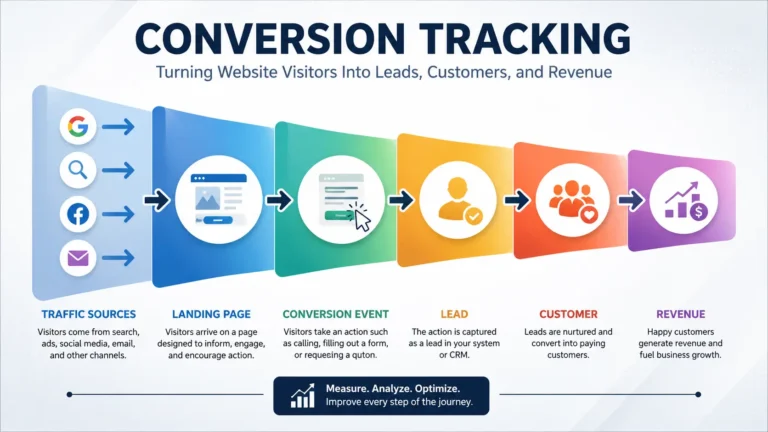
CTR is closely connected to conversion optimization. A high CTR means users are interested enough to click, but businesses still need strong landing pages and conversion-focused design to turn those visitors into customers. This is why CTR should be viewed as part of the larger customer journey: Impression → Click → Visit → Conversion → Customer. Improving CTR helps increase opportunities for the rest of that process to happen.
Related Glossary Terms:
PPC
CPC
Search Intent
Conversion Rate
Landing Pages
Google Ads
Impressions