Ranking:
How Search Engines Decide
Which Pages Appear First
Ranking is the process search engines use to decide which pages appear first in search results after those pages have already been crawled and indexed. Once a search engine understands that a page exists and has stored information about it, the next step is deciding how useful that page may be for a specific search query.
This is where ranking becomes important. Search engines do not simply list pages randomly. They try to organize results in a way that gives the searcher the most helpful, relevant, and trustworthy answers first.
Start Here: Introduction to Search Engine Marketing
Previous Article: SEO vs PPC: What’s the Difference?
For example, if someone searches for “emergency plumber near me,” the search engine wants to show pages that are closely related to emergency plumbing services, located near the searcher, easy to use, and likely to provide a good experience. A page about general home repairs may still be related, but it may not be as relevant as a page specifically focused on emergency plumbing.
Ranking Comes After Crawling and Indexing
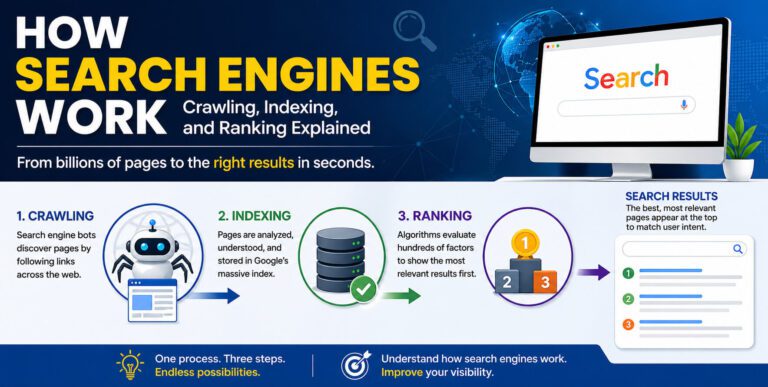
Before a page can rank, it usually needs to be discovered and indexed first. Crawling helps search engines find pages. Indexing helps search engines understand and store those pages. Ranking is the final step where the search engine decides which indexed pages deserve to appear higher in the results.
A simple way to think about it is this: crawling is discovery, indexing is understanding, and ranking is placement. If a page is not indexed, it generally cannot compete for rankings in normal search results.
Relevance: Does the Page Match the Search?
One of the most important ranking signals is relevance. Search engines look at whether the content on a page matches what the user is searching for. This includes the words used in the title, headings, paragraphs, image descriptions, links, and other parts of the page.
However, modern search engines are not only matching exact keywords. They also try to understand meaning, context, and search intent. This means a page can sometimes rank for searches that use different wording, as long as the content clearly answers the same type of question.
For example, a page about “how Google ranks local businesses” may also be relevant for searches such as “local ranking factors,” “how local SEO works,” or “why businesses show up in Google Maps.” The better the page explains the topic, the easier it becomes for search engines to connect that page with related searches.
Content Quality: Is the Page Helpful?
Search engines also look for content quality. A high-quality page usually gives clear, useful, and complete information. It should answer the searcher’s question without forcing them to dig through confusing, thin, or poorly organized content.
Good content is not just longer content. A page can be long and still be weak if it repeats the same idea without adding value. Strong content explains the topic clearly, covers the important points, and helps the reader understand what to do next.
For local businesses, content quality might include explaining services clearly, answering common customer questions, showing service areas, including useful examples, and making it easy for visitors to contact the business.
Usability: Is the Page Easy to Use?
Usability also affects how search engines evaluate pages. A page should load quickly, work well on mobile devices, be easy to read, and allow visitors to find important information without frustration.
If a page is slow, difficult to navigate, crowded with distractions, or hard to read on a phone, it may provide a poor user experience. Since many local searches happen on mobile devices, usability is especially important for businesses that depend on phone calls, directions, appointment requests, or quote forms.
A helpful page should make the next step obvious. If someone lands on a service page, they should be able to understand what the business offers, where it operates, and how to contact the business without having to search all over the site.
Authority: Can the Page and Website Be Trusted?
Authority is another important part of ranking. Search engines look for signs that a website is trustworthy, established, and useful within its topic or local market. Authority can be influenced by links from other websites, mentions of the business, reviews, citations, and the overall reputation of the site.
For local businesses, authority may come from consistent business information, strong customer reviews, local directory listings, industry-related links, and a well-maintained Google Business Profile. These signals can help search engines feel more confident that the business is legitimate and relevant to local searchers.
Authority does not mean a small business needs to become a national brand. It means the business should build trust within its own market, service area, and industry.
Ranking Is Based on Many Signals Working Together
No single factor controls rankings by itself. Search engines use many signals together to decide which pages should appear first. A page may have strong content but poor usability. Another page may be easy to use but not very relevant. The best-ranking pages usually combine relevance, quality, usability, and trust.
This is why search engine optimization is not just about adding keywords to a page. Keywords matter, but they are only one part of the larger process. A strong page should be relevant to the search, helpful to the reader, technically accessible, and supported by trust signals.
Why Ranking Matters for Local Businesses
For local businesses, ranking can directly affect phone calls, website visits, appointment requests, and leads. When a business appears higher in search results, more potential customers are likely to see it. When it appears lower, it may be overlooked, even if the business offers excellent service.
This is especially important for searches with local intent, such as “dentist near me,” “roof repair in my city,” or “best HVAC company nearby.” These searches often come from people who are close to making a decision. Ranking higher for the right searches can put a business in front of customers at the exact moment they need help.
The Main Idea Behind Search Rankings
The main goal of ranking is to match searchers with the best available result for their query. Search engines want to understand what the user needs, compare the available indexed pages, and display the results most likely to satisfy that search.
In simple terms, ranking is where search engines decide which pages deserve visibility. A page that is relevant, helpful, easy to use, and trustworthy has a better chance of appearing higher than a page that is unclear, thin, slow, or poorly connected to the searcher’s needs.
Why Relevance Matters
Relevance is one of the most important factors in how search engines rank pages. Their goal is simple: match each search query with the most useful and appropriate result. This means understanding not just the words a user types, but the intent behind those words.
For example, a search for “best running shoes” suggests the user is comparing options, so search engines will prioritize product reviews, comparison guides, and shopping pages.
On the other hand, a search like “emergency plumber near me” signals immediate need and local intent, so search engines will focus on nearby service providers that can respond quickly.
When your content closely aligns with what users are actually looking for, it becomes more relevant in the eyes of the search engine. This increases the likelihood that your page will appear higher in the results, because it helps deliver a better overall search experience.
In simple terms, the better your content matches user intent, the more likely it is to be shown to the right audience at the right time.
Why Some Websites Rank Higher than Others
Some websites rank higher because they do a better job of meeting both user and search engine expectations. There are some really great websites out there that really help search engines and visitors understand their content. A page that clearly explains a topic, answers the searcher’s question, and is easy to navigate has a better chance of performing well in search results.
Search engines look at several signals when comparing pages. These can include how relevant the content is, how helpful the information is, how well the page is organized, how fast the site loads, whether it works properly on mobile devices, and whether the website appears trustworthy.
A website may struggle to rank if the content is too thin, the headings are unclear, the page is hard to use, or important pages are not linked together properly. Technical problems can also hold a website back, especially if search engines have trouble crawling, indexing, or understanding the page.
The good news is that many ranking problems can be improved. Website owners can start by making their content clearer, adding helpful explanations, improving page structure, fixing broken links, speeding up slow pages, and making sure each important page has a clear purpose.
For local businesses, this often means creating better service pages, improving Google Business Profile information, answering common customer questions, and making it easier for visitors to call, request a quote, or book an appointment.
In future articles, we will look more closely at how to fix common website problems that prevent pages from ranking well. These “fixing websites” topics will cover practical improvements such as better content, stronger internal linking, cleaner page layouts, faster loading times, and simple changes that can help search engines understand your site more clearly.
How This Connects to Search Engine Marketing
Search Engine Marketing (SEM) is built on visibility, and that visibility depends entirely on how search engines crawl, index, and rank your content. Crawling allows search engines to discover your pages, indexing helps them understand and store your content, and ranking determines where your pages appear when someone searches.
If any one of these steps breaks down, your content may never reach your audience. This is why SEM is not just about ads or keywords—it starts with making sure your website can be found, understood, and evaluated correctly by search engines.
When businesses understand how these processes work, they can structure their content more effectively. This means creating clear, relevant pages that match user intent, organizing content with proper headings and internal links, and ensuring the site performs well from a technical standpoint.
In SEM, every improvement—whether it’s better content, faster load times, or stronger relevance—helps increase visibility, attract the right visitors, and ultimately generate more leads and conversions.
Key Takeaway
How Crawling, Indexing, and Ranking Work Together
-
- Crawling is how search engines discover pages
- Indexing is how they store and understand those pages
- Ranking is how they decide the order in which results appear
Each step builds on the one before it, turning raw web content into organized, searchable information that can be delivered instantly when a user performs a search.
Together, these processes form the foundation of search engines, ensuring that users are connected with the most relevant and helpful information as quickly and accurately as possible.
FAQ
How do search engines find websites?
Search engines use automated crawlers that discover content by following links.
What is indexing?
Indexing is the process of storing and organizing information for retrieval.
What determines rankings?
Rankings depend on relevance, quality, usability, and authority.