
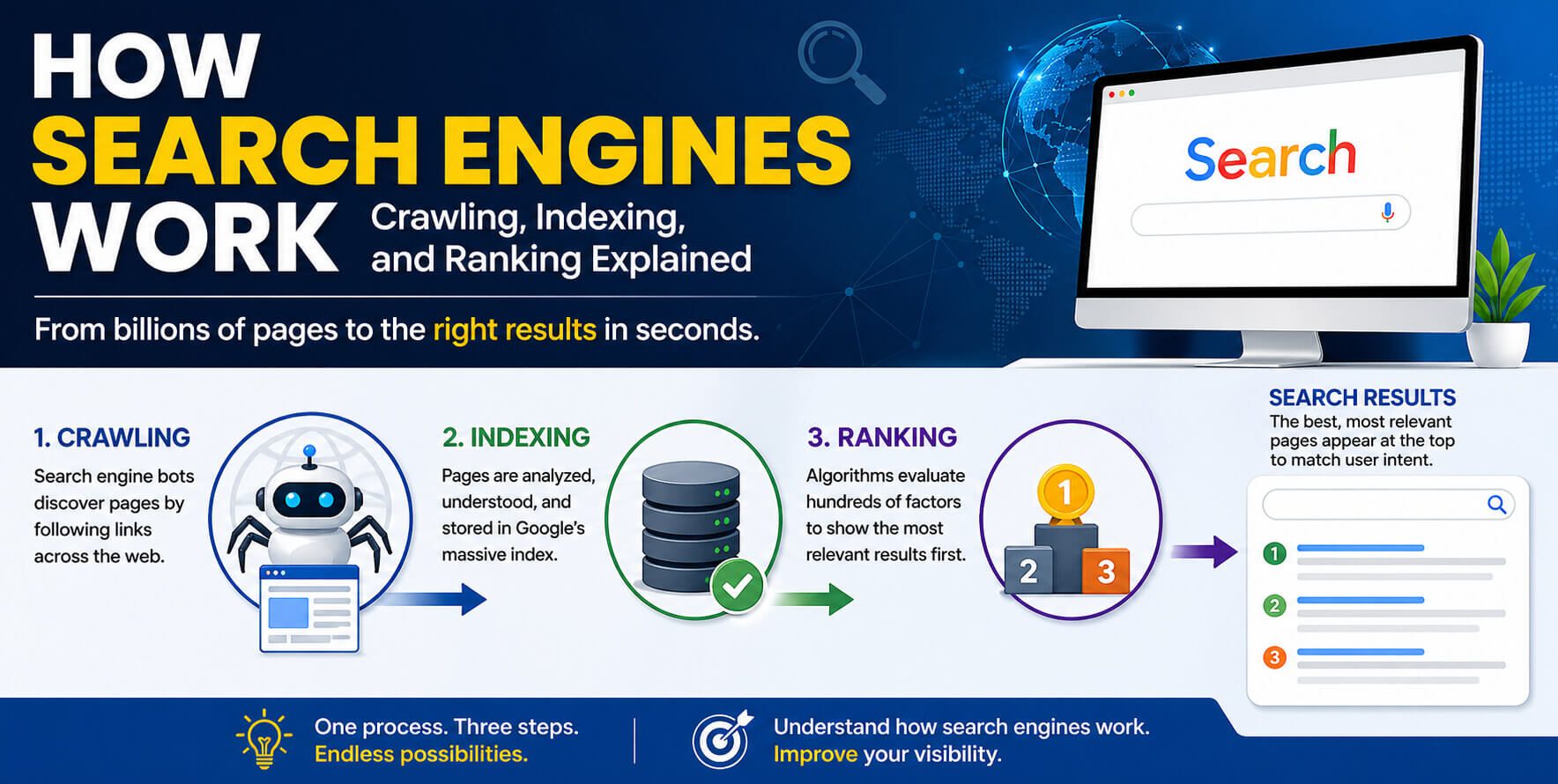
Search engines like Google help users find information online by crawling websites, indexing content, and ranking pages based on relevance and quality. When someone performs a search, the search engine analyzes its index to display results it believes best match the user’s query.
Start Here: Introduction to Search Engine Marketing
Previous Article: SEO vs PPC: What’s the Difference?
The goal of this article is to explain the basics of crawling, indexing, and ranking.
Search engines help people find information quickly by organizing vast amounts of content across the internet. When someone types a question or phrase into Google, the search engine scans its stored data and displays results it believes are most relevant and helpful.
Although the process happens in seconds, several important steps occur behind the scenes. Understanding how search engines work helps explain why some websites appear higher in search results than others.
The Search Engine Process at a Glance
Before diving deeper, here is a simple way to understand how search engines work. Search engines rely on three primary processes:
- Crawling → Discovering pages
- Indexing → Understanding and storing content
- Ranking → Ordering results based on usefulness
Each step plays an important role in determining which pages appear when someone performs a search.
What Is a Search Engine?
A search engine is a powerful software system designed to help users find information on the internet quickly and efficiently. Instead of manually browsing through millions—or even billions—of individual web pages, users can simply type a question, phrase, or keyword into a search bar and receive a curated list of relevant results within seconds.

At its core, a search engine acts as an organized gateway to the web. It continuously scans and indexes websites across the internet, storing information about their content, structure, and relevance. This allows the system to retrieve and display the most appropriate pages when a user performs a search. Without search engines, navigating the internet would be slow, chaotic, and extremely inefficient.
The most widely used search engines today include Google, Bing, and Yahoo. Each platform uses its own algorithms and ranking systems, but they all share the same primary goal: to connect users with the most useful and accurate information based on their search intent.
When a user enters a search query, the search engine analyzes the words and phrases used, interprets the intent behind the search, and then sorts through its index to find matching content. It ranks these results based on a variety of factors such as relevance, quality, authority, and user experience. The pages that best meet these criteria are displayed at the top of the search results.
For businesses—especially local businesses—search engines are more than just tools for finding information. They are powerful lead generation platforms. When someone searches for services like “plumber near me” or “best dentist in my area,” search engines determine which businesses appear in front of those potential customers. Understanding how search engines work is the first step toward getting your business found online and turning searches into real calls, leads, and revenue.
The Three Core Functions of Search Engines
Search engines perform three main tasks and these will be discussed in the next article.
- Crawling
- Indexing
- Ranking
Next Article: How Search Engines Work – Crawling – Step 1