The Foundation of Online Marketing
for Local Businesses
Continued from: Beginner’s Guide to Search Engine Marketing – Part 1
The Customer Search Journey
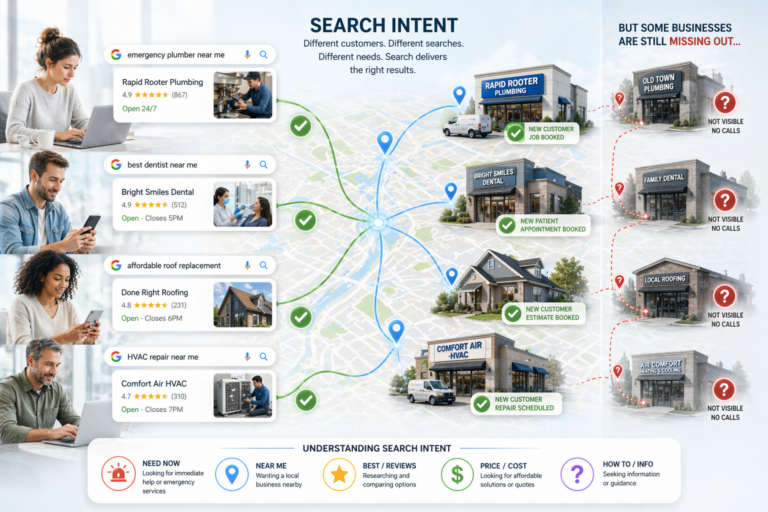
A customer does not always become a buyer after one search. Many people move through a journey before contacting a business. At the beginning, they may search for information. A homeowner might search for “why is my basement leaking” or “how much does roof repair cost.” At this stage, the person is trying to understand the problem.
Next, the person may compare options. They may search for “best roofing company near me,” “roof repair reviews,” or “flat roof repair contractor.” At this stage, the person is evaluating who can help.
Finally, the person may be ready to take action. They may search for “roof repair company open now,” “emergency roof leak repair,” or “book roofing inspection.” At this stage, the business that appears clearly, looks trustworthy, and makes contact easy has a major advantage. Good search marketing recognizes this journey. It does not only chase one keyword or one ranking. It creates useful entry points for people at different stages of decision-making.
The Wonderful Benefits of Using the Right Keywords
Keywords are the words and phrases people type into search engines. They are important because they reveal what potential customers are looking for.
- A local electrician might care about phrases such as “emergency electrician near me,” “panel upgrade cost,” “licensed electrician,” or “ceiling fan installation”.
- A dentist might care about phrases such as “family dentist,” “teeth cleaning”, “emergency dental appointment”, or “dental implants near me”.
Keyword research helps businesses understand demand. Instead of guessing what people search for, a business can use keyword data and search behavior to plan service pages, blog articles, Google Ads campaigns, and local landing pages. However, keywords should not be treated as isolated words to stuff into a page. The real goal is to understand the intent behind the keyword.
A person searching for “what is SEO” needs education. A person searching for “SEO company near me” may be comparing providers. A person searching for “hire local SEO consultant” may be close to making a decision. Strong search marketing connects keywords, intent, content, and offers.
Why Search Marketing Matters for Local Businesses
Think about your own behavior when you need a service. If your furnace stops working, you may search for an HVAC contractor. If a pipe bursts, you might search for an emergency plumber. If you need legal advice, accounting services, dental care, landscaping, or home repairs, chances are good that you begin your search online.
Your customers behave the same way. Search engines have become one of the primary ways people discover businesses, compare providers, read reviews, check locations, and make purchasing decisions. This makes search marketing one of the most valuable customer acquisition channels available.
Unlike many traditional advertising methods, search marketing allows businesses to reach people who are already expressing interest. The customer initiates the search because they have a need, a problem, or a goal. When your business appears at that moment, the opportunity is highly relevant. This is why search marketing can be so effective for local businesses. Instead of interrupting people who may not care, it helps businesses become visible when customers are actively looking for solutions.
What Makes Search Marketing Measurable
One of the major advantages of search marketing is that it can be measured. A business can track website visits, ad clicks, phone calls, form submissions, rankings, impressions, conversion rates, cost per lead, and return on investment. This does not mean every result is perfectly simple to measure. Some customers call after visiting multiple pages.
Some see a Google Business Profile before visiting the website. Some click an ad, leave, and return later through an organic result. However, search marketing still provides far more data than many older advertising channels. Measurement helps business owners make smarter decisions.
If a page receives traffic but produces no leads, the page may need a stronger call to action. If an ad gets clicks but no calls, the targeting or landing page may need improvement. If one service page produces most of the leads, it may make sense to build more supporting content around that topic. Good search marketing is not based on guessing. It is based on testing, improving, and tracking what happens over time.
A Simple Way to Think About Search Marketing
At its core, search engine marketing connects three things.
- First, people search for information, products, or services because they have a question, problem, or need.
- Second, businesses create websites, pages, ads, listings, and content that explain what they offer.
- Third, search engines attempt to match the searcher with the most relevant and useful result.
When these three pieces align correctly, businesses are more likely to attract qualified visitors and generate leads. Everything else in search marketing, from keywords and SEO to Google Ads and conversion optimization, is designed to improve that matching process.
Common Beginner Mistakes
Many beginners make the mistake of thinking one tactic will solve everything. They may believe that simply launching a website will bring customers, or that running ads will automatically produce profitable leads, or that adding keywords to a page is enough to rank. Search marketing does not usually work that way.
A website needs useful pages, clear structure, and a reason for visitors to take action. SEO needs time, relevance, content, trust, and consistency. Google Ads need proper targeting, budget control, and conversion tracking. Local SEO needs accurate business information, reviews, service relevance, and strong local signals.
Another common mistake is focusing only on traffic instead of leads. More visitors are useful only if those visitors are relevant and the website can convert them into calls, form submissions, appointments, or sales. A better approach is to build the system step by step. Start with clear positioning, useful pages, relevant keywords, a properly optimized business profile, and simple tracking. Then improve based on what the data shows.
What Makes This Guide Different
Many beginner marketing guides jump immediately into tactics. They teach individual techniques without first explaining the system those techniques belong to. This guide takes a different approach.
Rather than focusing on isolated tactics, it helps you understand how search marketing works as a complete lead-generation system. Once you understand the system, individual strategies become much easier to evaluate and implement.
You will learn not only what to do, but why it works. That understanding can help you make better decisions, avoid common mistakes, communicate more effectively with agencies and consultants, and build a stronger online presence over time.
How to Use This Beginner Series
This page is the starting point. It introduces the foundation. The rest of the guide can then explain the major parts of search engine marketing in a logical order.
Beginners will usually get the best results by reading the series in sequence. Start with the basic definition of search engine marketing. Then move into SEO, paid advertising, keywords, search intent, traffic, conversions, and measurement.
If you already understand one topic, you can jump ahead. However, the real value comes from seeing how the pieces connect. Search marketing becomes far less confusing when you stop treating SEO, ads, content, websites, and analytics as separate topics. They are all parts of the same customer acquisition system.
Your Next Step
Now that you understand the purpose of search engine marketing and why it matters, the next step is to learn exactly what SEM is and how it differs from other forms of digital marketing. The next article will introduce the core concept of Search Engine Marketing and explain how SEO and paid advertising work together to help businesses attract customers online.
Continue Reading: What Is Search Engine Marketing?