Crawling:
How Search Engines
Discover Pages
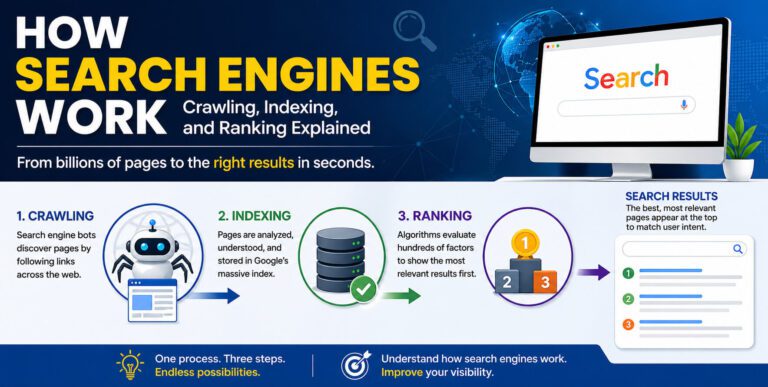
Search engines use automated programs to discover content across the internet and identify pages that may be useful to searchers. These programs are called:
-
crawlers – programs used by search engines to systematically browse websites and discover new or updated pages
-
spiders – just another term for crawlers, emphasizing how they “crawl” across the web by following links from one page to another.
-
and bots – A broader term for automated software that performs tasks online, including crawling websites, indexing content, or interacting with web pages.
Continued From: How Search Engines Work – in 3 Steps
Start Here: Search Engine Marketing Guide
These programs follow links from one page to another and scan your website to understand its structure and the information it contains. It’s “The Links” within your website that helps search engines find new content more efficiently. Without being able to crawl your site, search engines would not even know that a page actually exists.
So, before your page can rank in Google, it first has to be discovered. And discovery comes through crawling.  A crawler works by visiting a known page, reading the information on that page, and then following the links it finds to other pages.
For example, if a crawler lands on your homepage and sees links to your service pages, blog posts, contact page, and location pages, it may follow those links to discover more of your website.
This is one reason internal linking is so important. A page that has no links pointing to it can be harder for search engines to find. These are sometimes called orphan pages because they exist on the website but are not properly connected to the rest of the site. If search engines cannot easily discover a page, that page may struggle to appear in search results, even if the content itself is useful.
Crawlers also pay attention to images and videos, but they need extra help understanding them. A search engine cannot interpret an image the same way a person can. That is why image file names, alt text, captions, and nearby text can all provide useful context. For example, an image named emergency-plumber-winnipeg.jpg is more descriptive than an image named IMG_4827.jpg.
However, the written content on the page is what provides the strongest context for search engines. The written word itself is what gives search engines the context it needs
Headings, subheadings, paragraphs,
and related phrases
all help explain the topic of the page.
For a local business website, this might include services offered, cities served, customer problems, solutions, pricing explanations, frequently asked questions, and contact details.
Links are another major part of crawling. Crawlers use links as pathways. Internal links help search engines move through your own website, while external links point to other websites. A clean internal linking structure helps search engines understand which pages are important and how different topics are related.
For example, a local SEO article might link to a Google Business Profile guide, a local reviews article, and a page about turning website visitors into phone calls. Those links help both readers and search engines move naturally through related topics. This creates a stronger website structure instead of leaving each article isolated on its own.
Page structure also matters. A well-organized page with a clear title, proper headings, readable paragraphs, descriptive links and logical sections is easier for both people and crawlers to understand. When a page is messy, poorly formatted, or filled with confusing code, search engines may have a harder time interpreting its purpose.
Crawling does not automatically mean a page will rank. It simply means the search engine has discovered the page and gathered information from it. After crawling, the search engine may decide whether the page should be indexed or not.
Indexing is the next step, where the page may be stored in the search engine’s database and become eligible to appear in search results. But please know this:
A page can be crawled but not indexed
That may happen if the page is too thin, duplicated, blocked, low quality, or not considered useful enough compared to other pages. So crawling is only the beginning, but without crawling, the rest of the search process cannot happen.
For local businesses, crawling is especially important because every important page needs to be discoverable. A homepage, service pages, location pages, contact page, and helpful articles should all be connected in a way that makes sense. If a plumber has separate pages for drain cleaning, water heater repair, emergency plumbing, and sewer line service, those pages should not be hidden deep inside the site with no clear links pointing to them.
A simple way to think about crawling is this:
search engines need a map of your website. Internal links, menus, sitemaps, and clean structure all help create that map. The easier the map is to follow, the easier it is for crawlers to discover and understand your content.
There are also technical problems that can interfere with crawling. There could be problems with:
- Broken links: – hyperlinks that lead to non-existent or unavailable pages, preventing search engine crawlers and users from accessing content and negatively impacting SEO performance.
- Blocked pages: – sections of a website that search engines cannot access due to restrictions like robots.txt rules or server settings, limiting their ability to be crawled and indexed.
- Slow-loading pages: – Slow-loading pages are web pages that take too long to fully display content, reducing crawl efficiency, harming user experience, and negatively affecting search engine rankings.
- Incorrect robots.txt settings: – occurs when the robots.txt file mistakenly blocks important pages or resources, preventing search engines from properly crawling and indexing a website.
- Noindex tags: – HTML directives that tell search engines not to include specific pages in search results, which can unintentionally remove valuable content from being indexed if misused.
- Redirect problems: – redirects get reconfigured, create loops, or lead to irrelevant pages, confusing search engines and disrupting proper crawling and indexing.
- Duplicate URLs: – multiple web addresses displaying the same or very similar content, which can dilute ranking signals and cause search engines to struggle with determining the preferred version to index.
All of these can all create confusion. Even strong content can under perform if search engines have trouble accessing it properly. This is why SEO is not only about writing articles or adding keywords. The site itself has to be accessible.
Search engines need to be able to reach the pages, read the content, follow the links, and understand the structure. When that foundation is weak, the website may have trouble earning visibility even if the business is legitimate and the content is helpful.
For a small business owner, the main lesson is simple. Your website should not be a collection of random pages. It should be organized like a clear pathway. Important pages should be easy to find from the homepage, related pages should link to each other, and every major service or topic should have a logical place on the site.
When crawling works properly, search engines can discover your content more efficiently. That gives your pages a better chance of moving to the next stage: indexing. From there, Google and other search engines can evaluate whether your pages deserve to appear when potential customers search for the services you offer.
Crawling is just the first step in the search visibility process.
If search engines cannot find your pages, they cannot index them. If they cannot index them, they cannot rank them. And if they cannot rank them, your business has fewer chances to be found by people searching online.