If you’re trying to rank in Google Maps and show up in the Local Pack, you’re not just chasing traffic—you’re positioning your business in front of people who are ready to call, visit, or buy. When someone searches for a service like “plumber near me” or “best electrician in Winnipeg,” Google often displays a map with three business listings at the top. This is known as the Local Pack, and it’s where the majority of high-intent clicks happen.
This guide will walk you step-by-step through how to improve your Google Maps ranking, increase visibility, and turn searches into real leads.
This article is Part 2 of our 10-part Local SEO series answering the question: “How do I get my business to rank on Google and generate leads from those rankings?”
👉 Previous Article: How Google Finds and Ranks Local Businesses
The 3 Core Factors That Drive Local Rankings
Before you can consistently rank higher in Google Maps, you need to understand the three main Google Maps ranking factors that determine visibility in local search results.
Relevance
Relevance refers to how well your business matches what someone is searching for. The more clearly your services, categories, and content align with a search query, the easier it is for Google to show your listing.
Distance (Proximity)
Distance is based on how close your business is to the person searching. While you can’t control where someone searches from, you can strengthen your local signals to improve visibility within your service area.
Prominence
Prominence reflects how well-known and trusted your business is online. Reviews, backlinks, citations, and overall online presence all contribute to this factor.
Every strategy you apply to improve your Google Maps SEO will fall into one of these three categories.
What Is the Local Pack?
The Local Pack is the group of three business listings that appear at the top of local search results, just below the map. Each listing typically includes your business name, reviews, contact details, and a direct way to call or get directions. Because of its visibility, Local Pack ranking often drives more engagement than traditional organic listings.
Unlike standard SEO results, these rankings are heavily influenced by your Google Business Profile and local signals rather than just your website.
Step 1: Set Up and Verify Your Google Business Profile
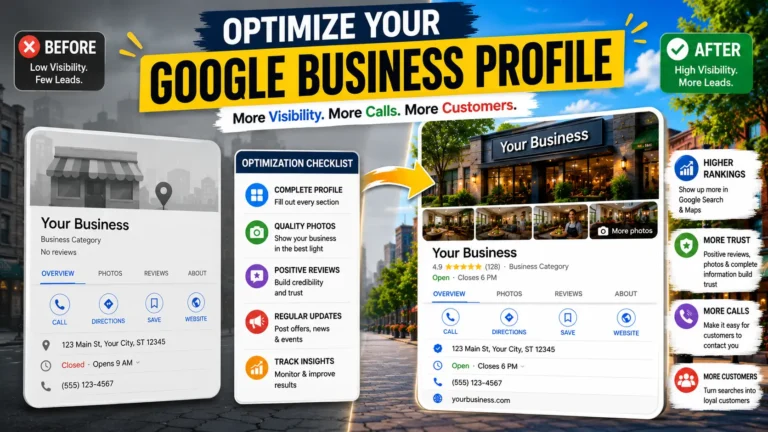
Your Google Business Profile is the foundation of your ability to rank in Google Maps. Without a verified and accurate listing, your chances of appearing in the Local Pack are extremely limited. Make sure your profile includes:
- Accurate business name
- Correct address or service area
- Verified phone number
- Proper website link
This step establishes trust and confirms to Google that your business is legitimate and active.
Step 2: Fully Optimize Your Google Business Profile
Once your listing is verified, the next step is Google Business Profile optimization. This is where many businesses fall short, leaving ranking opportunities on the table. Focus on completing every section of your profile:
- Primary and secondary business categories
- Detailed business description with local keywords
- Services and products
- High-quality photos
- Accurate business hours
- Regular posts and updates
Choosing the correct category is especially important, as it directly impacts how Google understands your business and where it should appear in search results.
Step 3: Build Local Citations and Ensure NAP Consistency
Local citations are mentions of your business across directories and websites. These listings help confirm your business information and improve your credibility.
Your Name, Address, and Phone number—often referred to as NAP consistency—must match exactly across all platforms. Focus on:
- Local directories
- Industry-specific listings
- Cleaning up duplicate listings
- Ensuring consistent business information
Even small inconsistencies can weaken your local SEO performance.
Step 4: Generate and Manage Google Reviews
Reviews are one of the strongest Google reviews ranking factors and also play a major role in converting visitors into customers. Google evaluates:
- Review volume
- Review quality
- Review frequency
- Business responses to reviews
Encourage satisfied customers to leave reviews and respond to every review you receive. This shows engagement and builds trust. Businesses with strong review profiles often outperform competitors—even if they’re not ranked first.
Step 5: Optimize Your Website for Local SEO
While your Business Profile drives Maps visibility, your website supports your local SEO ranking and strengthens trust signals. Key areas to focus on include:
- Service pages for each offering
- City or location-based pages
- Strategic use of location-based keywords
- Mobile-friendly design
- Fast loading speeds
Your website helps reinforce your relevance and authority, which contributes to your overall Google Maps ranking.
Step 6: Build Local Backlinks to Increase Authority
Local backlinks help build your business’s prominence and credibility in your area. Effective strategies include:
- Local sponsorships
- Community partnerships
- Chamber of commerce listings
- Local news and press mentions
The more relevant and trusted your backlinks are, the stronger your local authority becomes.
Step 7: Improve Engagement Signals
User engagement plays a growing role in how Google evaluates your listing. Important signals include:
- Clicks on your listing
- Phone calls
- Direction requests
- Website visits
When users consistently interact with your listing, it reinforces your relevance and trustworthiness.
Common Mistakes That Hurt Your Google Maps Ranking
Many businesses struggle to rank because of avoidable issues. Common Google Maps ranking problems include:
- Using fake or inaccurate addresses
- Adding keywords unnaturally to business names
- Inconsistent citations across directories
- Ignoring negative reviews
Fixing these issues alone can significantly improve your visibility.
Summary: How to Rank Higher in Google Maps Consistently
To consistently rank higher in Google Maps, your strategy needs to focus on completeness, accuracy, and trust. When your business is properly optimized, consistently listed across the web, and actively engaging with customers, Google is far more likely to place you in the Local Pack. And when that happens, visibility turns into calls, and calls turn into customers.
FAQ: Google Maps Ranking Questions Answered
It can take anywhere from a few weeks to several months depending on your competition, location, and how well your listing is optimized.
Your Google Business Profile optimization, combined with reviews and local relevance, plays the biggest role.
Yes, but it requires strong local signals, location pages, and consistent citation building for each area.
Yes. Reviews influence both your visibility and how likely users are to choose your business.
Next Article: What Makes Google Trust Your Business
Recommended Reading: Local SEO Guide