What Is Search Engine Marketing (SEM)?
Search Engine Marketing (SEM) is the process of helping a business become more visible when people search online. Every day, millions of people turn to search engines to find answers, compare products, research services, and solve problems. SEM helps businesses appear in front of those people at the exact moment they are looking for information. At its core, Search Engine Marketing consists of two primary strategies:
- Search Engine Optimization (SEO), which focuses earning free organic traffic from search engines through better content and website optimization
- Pay-Per-Click advertising (PPC), which focuses on purchasing visibility through paid advertisements that appear in search results.
Together, these strategies help businesses connect with potential customers who are actively searching for solutions. Search Engine Optimization (SEO) and Pay-Per-Click Advertising (PPC). SEO focuses on earning free traffic . PPC focuses on purchasing visibility through paid advertisements that appear in search results.
Continued from: Customer Search Journey
Start Here: Beginner’s Guide to Search Engine Marketing
Search Engine Marketing Explained Simply
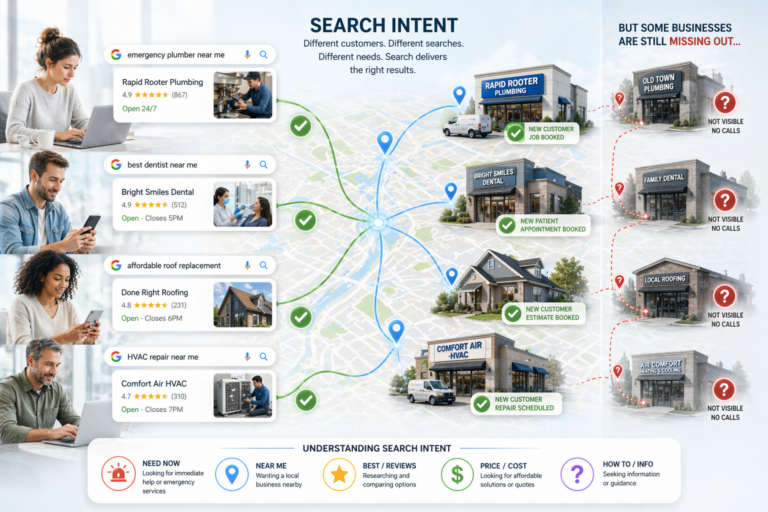
Imagine a homeowner discovers a leaking water heater. They immediately grab their phone and search for “water heater repair near me.” Within seconds, Google displays a list of businesses that may be able to help. Some of those businesses appear because they have earned strong rankings through SEO. Others appear because they are running paid advertisements through Google Ads.
Both are examples of Search Engine Marketing in action. The goal of SEM is simple. It helps businesses become visible when potential customers are already looking for what they offer. Unlike many forms of advertising that interrupt people while they are doing something else, search marketing connects businesses with people who are actively seeking information, products, or services.
Why Search Engine Marketing Matters
Search engines have become one of the most important tools consumers use before making decisions. Whether someone needs a plumber, a lawyer, a dentist, a restaurant, or accounting software, there is a good chance they will begin their journey with a search. People search because they have a need. Sometimes they are gathering information. Sometimes they are comparing options.
Sometimes they are ready to make a purchase immediately. This is why search traffic is often considered highly valuable. The visitor already has intent. They are not being interrupted by an advertisement while scrolling social media or watching videos. They are actively searching for a solution. For businesses, this creates an opportunity to appear at exactly the right moment in the customer’s decision-making process.
The Two Main Components of Search Engine Marketing
1: Search Engine Optimization (SEO)
Search Engine Optimization focuses on improving a website so it can earn visibility in the organic search results. Organic results are the listings that appear naturally based on Google’s assessment of relevance, quality, and usefulness. SEO involves creating helpful content, organizing a website properly, targeting relevant keywords, improving page speed, and building trust with search engines over time.
One of the biggest advantages of SEO is that traffic does not require payment for every visitor. Once pages begin ranking well, they can continue generating traffic for months or even years. The downside is that SEO usually takes time. Results rarely happen overnight, especially in competitive industries.
Pay-Per-Click Advertising (PPC)
Pay-Per-Click advertising allows businesses to pay for visibility in search results. The most popular PPC platform is Google Ads. With PPC, advertisers bid on keywords related to their services. When users search for those terms, ads may appear above or alongside the organic results. As the name suggests, advertisers generally pay when someone clicks their ad. The major advantage of PPC is speed.
Businesses can often begin generating traffic and leads almost immediately after launching a campaign. PPC also provides precise control over budgets, locations, audiences, and targeting options. Many successful businesses use both SEO and PPC together because each strategy offers unique advantages.
How Search Engines Connect Customers and Businesses
Search engines have one primary goal: providing the most helpful results for every search. When someone enters a search query, Google evaluates thousands of potential pages and advertisements. It then attempts to determine which results are most likely to satisfy the user’s needs.
To make these decisions, search engines consider many factors, including the relevance of the content, the quality of the website, the location of the searcher, the authority of the business, and the overall user experience. The closer a business aligns with what a customer is searching for, the greater its opportunity to appear in the search results. Search Engine Marketing focuses on improving that alignment.
Real-World Examples of Search Engine Marketing
A homeowner searching for “emergency plumber near me” will likely see a combination of paid ads, local map listings, and organic search results. Plumbing companies that invest in SEO or PPC have the opportunity to appear in front of that customer. A small business owner searching for “best accounting software for small businesses” may see software companies competing through both organic content and paid advertisements.
I experienced this myself after breaking a crown on one of my back molars. My regular dentist was closed, and I needed help immediately. I searched for “emergency dentist open today“. Google displayed several options, including sponsored listings, map results, and local dental offices. Once I refined the search to focus on nearby locations, the results became even more relevant.
That search solved a real problem. It connected my immediate need with businesses capable of providing a solution. This is exactly what Search Engine Marketing is designed to accomplish.
How Search Engine Marketing Generates Leads
For many businesses, the ultimate goal of SEM is lead generation. When potential customers find a business through search, they may call the company, fill out a contact form, request a quote, schedule an appointment, or make a purchase. Because these visitors often have strong buying intent, search marketing can produce measurable business results. One advantage of SEM is that nearly everything can be tracked.
Businesses can measure website visits, ad clicks, phone calls, form submissions, conversion rates, cost per lead, and return on investment. This ability to measure performance allows businesses to make informed decisions and continuously improve their marketing efforts.
How Search Marketing Differs From Other Marketing Channels
Many marketing channels focus on capturing attention. Search marketing focuses on capturing intent. Social media marketing places content in front of users while they browse their feeds. Display advertising shows visual ads while people visit websites. Traditional advertising often interrupts whatever the audience is currently doing.
Search marketing works differently. Instead of interrupting people, it responds to a question, problem, or need that already exists. Because of this, search traffic frequently converts better than many other traffic sources. The visitor is already interested. The challenge is simply being visible when they search.
Who Can Benefit From Search Engine Marketing?
Search Engine Marketing can benefit almost any business whose customers search online. Local service providers often rely heavily on search visibility because customers frequently search for nearby solutions. Professional services such as lawyers, accountants, consultants, and agencies also depend on search traffic to attract new clients. Online stores use search marketing to attract buyers researching products.
Software companies use search marketing to generate trials and subscriptions. Healthcare providers use search marketing to connect with patients seeking treatment options. If people search for the products or services you provide, Search Engine Marketing can help increase your visibility and attract potential customers.
Search Engine Marketing connects customer needs, business solutions, and search engine technology. When those three elements work together effectively, businesses can attract more qualified visitors, generate more leads, and create more opportunities for growth.
Conclusion
Search Engine Marketing is one of the most effective ways to connect with potential customers because it targets people who are already searching for solutions. By combining Search Engine Optimization and Pay-Per-Click Advertising, businesses can improve visibility, attract qualified traffic, and generate measurable results.
Whether someone is looking for an emergency dentist, a local plumber, accounting software, or professional services, search engines help connect those needs with the businesses capable of solving them. Understanding how SEM works is the first step toward building a successful online marketing strategy.
FAQ Section
What does Search Engine Marketing include?
Search Engine Marketing typically includes Search Engine Optimization (SEO) and Pay-Per-Click Advertising (PPC). Together, these strategies help businesses increase visibility in search results.
Is SEM the same as SEO?
No. SEO is one component of SEM. Search Engine Marketing includes both organic search optimization and paid search advertising.
How long does SEM take to produce results?
PPC campaigns can generate traffic quickly, while SEO typically requires consistent effort over time before strong rankings develop.
Do small businesses need Search Engine Marketing?
Yes. Many small businesses depend on search engines to help customers find their services, especially in local markets.
Continue Reading: SEO vs PPC: What’s the Difference?