The Foundation of Online Marketing
for Local Businesses
A Beginner’s Guide to
Search Engine Marketing
If you own a local business, freelance professionally, or manage marketing for a company, you have probably heard people talk about SEO, Google Ads, rankings, keywords, and online leads. You may also have noticed competitors appearing prominently in Google search results while your own business struggles to gain the same visibility.
For many beginners, search marketing can feel confusing. There are countless articles, videos, tools, and opinions available online, yet much of the information assumes prior experience or focuses on only one piece of the puzzle. One resource explains keywords. Another talks about Google Ads. Another discusses website traffic. Another focuses on SEO. Before long, the topic feels scattered and difficult to organize.
Business owners usually do not start with technical questions. They start with practical questions.
- How do businesses show up on Google?
- Why do some companies appear first while others seem invisible?
- Is SEO better than advertising?
- How much should marketing cost?
- How does a website actually generate customers?
- Why does one competitor seem to get all the calls while another business barely gets noticed?
The purpose of this guide is to answer those questions in plain language.
Search Engine Marketing, often abbreviated as SEM, is the process of helping your business become visible when people search online. Whether someone is looking for a plumber, dentist, roofing contractor, accountant, lawyer, electrician, landscaper, or marketing agency, search engines attempt to connect that person with the most relevant solution.
Every day, people search because they need information, services, products, comparisons, prices, reviews, directions, appointments, or answers. Some searchers are only beginning to research. Others are comparing options before making a decision. Many are already prepared to call, book, buy, or request a quote. When your business appears at the moment someone is searching for help, you have an opportunity to earn attention, build trust, and potentially win a new customer. That is the power of search marketing.
This guide explains how the process works, how search engines connect customers with businesses, and how local companies can use search marketing principles to generate leads more consistently.
Who This Guide Is For
This guide was created specifically for beginners. You do not need a marketing degree, technical background, or previous SEO experience to understand the concepts discussed here.
If you own a local business and want more leads, this guide is for you. If you are considering hiring an SEO company, advertising manager, freelancer, or marketing agency and want to understand what they actually do, this guide is for you. If you have built a website but are unsure how people are supposed to find it, this guide is also for you.
It is also useful for freelancers, new marketers, entrepreneurs, and anyone interested in understanding how businesses attract customers through search engines.
The goal is not to overwhelm you with technical jargon. The goal is to help you understand the big picture first. Once you understand the fundamentals, more advanced topics such as keyword research, local SEO, paid advertising, landing pages, analytics, and conversion tracking become much easier to understand.
Where Many Business Owners Start
Most business owners already know that online visibility matters. They know customers are searching online. They know competitors are receiving calls and inquiries from Google. What they often do not know is how the process works behind the scenes.
Many have already invested time and money trying different marketing activities. They may have built a website, created social media profiles, experimented with advertising, hired a marketing company, purchased software, or spent hours reading online advice.
Despite these efforts, the results often feel unpredictable. One month the phone rings. The next month it goes quiet. A competitor appears in the map results. Another competitor runs ads above everyone else. A third competitor seems to have dozens of reviews, service pages, and helpful articles. Meanwhile, the business owner is left wondering what actually matters.
This confusion is normal because search marketing is not one single activity. It is a system made up of several connected parts. A website matters, but a website alone does not guarantee traffic. Keywords matter, but keywords alone do not generate leads.
Google Ads can produce visibility quickly, but ads still need strong targeting, relevant landing pages, and proper tracking. SEO can build long-term visibility, but SEO requires patience, structure, content, authority, and trust. Most resources explain these pieces separately. This guide brings them together into a simple framework.
What Search Engine Marketing Really Means
Search Engine Marketing is the practice of helping a business appear in search results when potential customers are looking for something relevant. In common usage, SEM can refer to paid search advertising, organic search optimization, or the broader system that includes both SEO and PPC. For a beginner, it is most useful to think of search engine marketing as the complete process of getting found through search engines and turning that attention into business results.
That process includes understanding what customers search for, creating pages and listings that match those searches, improving visibility in organic results, using paid ads when appropriate, and making sure visitors can easily take action once they reach your website or business profile. In other words, search marketing is not just about getting more traffic. It is about connecting the right people with the right offer at the right moment.
How Google Connects Customers to Businesses
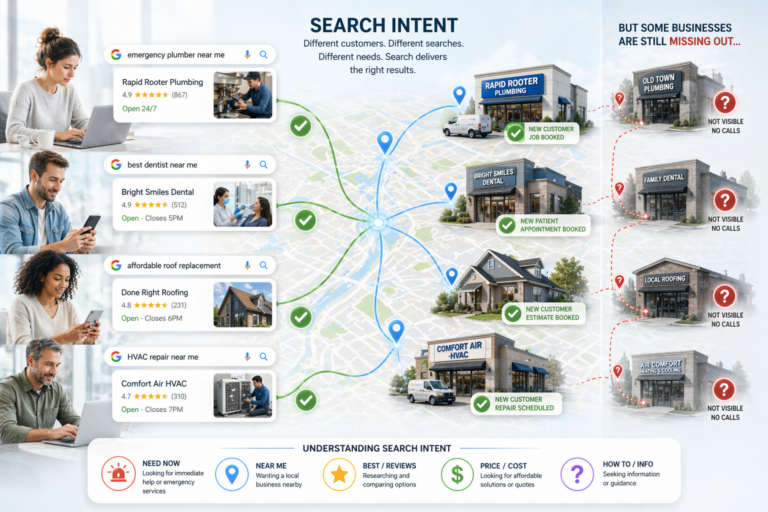
When someone searches on Google, the search engine tries to understand what that person wants. This is known as search intent. A person searching for “how does SEO work” probably wants information. A person searching for “best plumber near me” likely wants to compare local providers. A person searching for “emergency plumber open now” may be ready to call immediately.
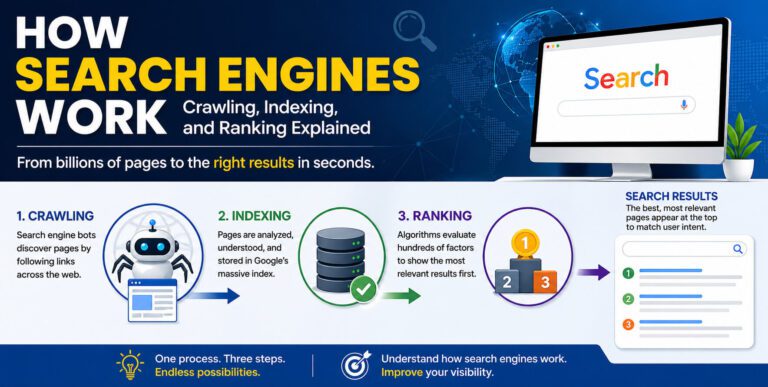
Google then attempts to show results that match that intent. Depending on the search, the results may include paid ads, map listings, organic website results, videos, images, business profiles, review snippets, shopping results, or informational articles.
For local businesses, this is especially important because many searches include local intent even when the searcher does not type a city name. Someone searching for “dentist near me”, “roof repair”, or “coffee shop”, is usually looking for a nearby provider. Google uses signals such as location, relevance, business information, website content, reviews, and trust to decide which results to show.
This means a local business needs more than a basic website. It needs a clear online presence that helps search engines understand what the business does, where it operates, who it serves, and why customers should trust it.
The Main Parts of Search Marketing
Although the search marketing process can become advanced, the beginner version can be understood through a few major parts. SEO, or Search Engine Optimization, focuses on improving your visibility in organic search results. These are the unpaid results that appear because Google believes a page, listing, or website is relevant and trustworthy.
SEO includes keyword research, website structure, content creation, technical improvements, internal linking, local optimization, and authority building. PPC, or Pay-Per-Click advertising, focuses on paid visibility. With Google Ads, a business can pay to appear for specific searches. The business is typically charged when someone clicks the ad. PPC can generate traffic faster than SEO, but it requires budget control, strong targeting, good landing pages, and careful tracking.
Local SEO focuses on helping a business appear for searches in a specific geographic area. This includes Google Business Profile optimization, map rankings, local citations, reviews, local content, service pages, and location relevance. Conversion optimization focuses on what happens after someone finds the business. A visitor may land on a website, view a service page, read reviews, click a phone number, fill out a form, or leave without taking action. Conversion optimization improves the chances that visitors become leads or customers.
Analytics and tracking help business owners understand what is working. Without tracking, it is difficult to know which pages, ads, keywords, calls, forms, or campaigns are producing results. These parts work best when they support each other. SEO can bring long-term traffic. PPC can test offers and generate faster visibility. Local SEO can increase map exposure. Conversion optimization can turn more visitors into leads. Tracking can show where to improve next.
Continue to Part 2 of Beginner’s Guide to Search Engine Marketing – Customer Search Journey