What Happens After Someone Searches
for a Local Business?
–
(The Data Most Businesses Ignore)
When someone searches for a local business on Google, they’re not just browsing. They’re trying to solve a problem — often immediately.
This is one of the most important (and misunderstood) facts about search engine marketing for local businesses. Traffic from search engines is not passive. It is driven by intent — and in many cases, that intent is urgent. If you understand what happens after a local search, you stop thinking in terms of “website visitors” and start thinking in terms of real customers.
The Most Important Statistic in Local Search
According to widely cited data from Google, 76% of people who search for a local business on their smartphone visit that business within 24 hours. This statistic alone changes how you should think about search engine marketing.
It tells you that local search is not just about visibility. It is about timing. It is about showing up at the exact moment when someone is ready to take action. Unlike other marketing channels where you are trying to create demand, local search captures demand that already exists.
Breaking Down What That 76% Really Means
At first glance, “76% visit within 24 hours” sounds impressive. But its real value comes from understanding what is happening behind that number. It means that most people who search for a local service are already deep into the decision-making process. They are not researching broadly. They are narrowing down their options.
In practical terms, that search often looks like:
- “plumber near me”
- “best dentist in my area”
- “emergency HVAC repair”
These are not informational searches. These are action-driven searches. So when someone performs that search, they are not asking “should I buy?” — they are asking “who should I buy from?”
Local Search Is a Compressed Customer Journey
In traditional marketing, the customer journey can take days, weeks, or even months. With local search, that journey is often compressed into minutes or hours. Here’s what typically happens:
- A need arises (broken pipe, tooth pain, empty fridge, etc.)
- The user searches on Google
- They scan the top results (Maps, ads, organic listings)
- They click, call, or get directions
- They visit or book a service
This entire process can happen in under 30 minutes. That’s why local search traffic is so valuable. It sits at the intersection of intent, urgency, and proximity.
Supporting Statistics That Reinforce the Pattern
The 76% statistic is not isolated. It is part of a broader pattern of high-intent behavior in local search. Other widely cited data points include:
- A significant percentage of mobile users call a business directly from search results
- Many local searches result in in-person visits the same day
- A meaningful portion of those visits lead to purchases
Individually, these statistics are useful. Together, they tell a clear story:
Local search is one of the fastest paths from discovery to revenue.
Why Most Businesses Still Miss These Customers
If the opportunity is so clear, why do so many businesses fail to capture it?
The answer is not a lack of demand. It is a lack of visibility and readiness. Most losses happen at one of these points:
- The business does not appear in search results at all
- The Google Business Profile is incomplete or un-optimized
- Reviews are weak, outdated, or missing
- The website is slow, confusing, or not mobile-friendly
- There is no clear call-to-action (call, book, directions)
Each of these issues creates friction. And in local search, friction kills conversions. When users are ready to act, even small barriers will push them toward a competitor.
The Real Meaning of “Missed Opportunities”
When you look at a funnel diagram, it’s easy to think in percentages. But behind those percentages are real people. Every time your business fails to appear — or fails to convert — those customers do not disappear. They choose someone else.
This is what makes local search so unforgiving. You are not competing for attention in a general sense. You are competing at the exact moment someone is ready to make a decision. That is why even small improvements in visibility or conversion can have an outsized impact on revenue.
How to Use These Statistics in Your Marketing Strategy
Understanding the data is only useful if you apply it. Here’s how local businesses should use these insights:
1. Prioritize Visibility Over Volume
You don’t need more traffic. You need to show up for the right searches. Focus on ranking for high-intent keywords like “near me” searches and service-specific queries.
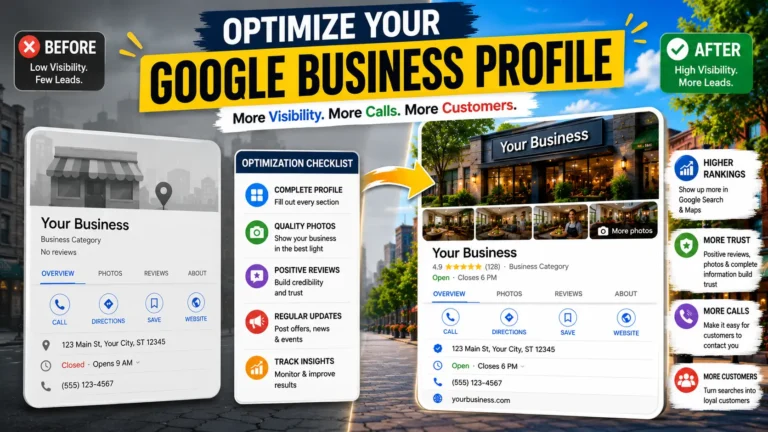
2. Optimize Your Google Business Profile
Your Google listing is often the first impression a customer sees. Make sure it is complete, accurate, and regularly updated with:
- Correct business information
- Categories and services
- Photos and updates
- Customer reviews
3. Make Action Easy
If someone is ready to act, don’t slow them down. Your website and listing should make it easy to:
- Call your business
- Get directions
- Book a service
4. Use Paid Ads to Capture Immediate Demand
If you’re not ranking organically yet, paid ads can put you in front of customers immediately. This is especially important for competitive industries or urgent services.
5. Improve Conversion Points
Even if you get the click, you still need to convert it. Focus on:
- Fast load times
- Clear messaging
- Trust signals (reviews, testimonials)
- Simple contact options
Why This Matters More Than Ever
Search behavior is evolving, but one thing remains constant: people use search engines when they need something. Local search, in particular, represents one of the clearest expressions of that need.
As competition increases, the businesses that win are not necessarily the biggest. They are the ones that are most visible and easiest to choose.
Final Thought
The next time someone searches for a business like yours, they are not looking for information. They are looking for a solution. The data shows that most of them will act quickly.The only question is whether your business is there when it matters.
Confused? Start Here: Local SEO Guide