Proximity
How Distance Influences
Local Search Results
and Google Maps Rankings
Proximity is one of the three core local ranking factors Google uses to determine which businesses appear in local search results. It refers to how physically close a business is to the searcher or to the location mentioned in the search query.
When people perform local searches, Google tries to show businesses that are not only relevant, but also convenient and geographically accessible. This is especially important for mobile users who are often searching while actively looking for a nearby service, store, restaurant, or contractor. For many local searches, proximity can heavily influence which businesses appear in Google Maps, the Local Pack, and local organic search results.
What Is Proximity?
Proximity measures physical distance between the searcher and the business. If someone searches “coffee shop near me,” Google will typically prioritize coffee shops located close to the user’s current location. If the user includes a city, neighborhood, or area name in the search, Google may use that location instead of the user’s real-time location.
For example:
- “Dentist near me” may use the user’s device location
- “Dentist in Winnipeg” may prioritize Winnipeg businesses
- “Pizza near Polo Park” may focus on businesses near that area
This is why local search results often vary depending on where the user is searching from. Someone searching from downtown may see very different businesses than someone searching from the suburbs, even when using similar search terms.
How Proximity Works in Local Search
Google uses multiple forms of location data to estimate proximity. This can include GPS signals from mobile devices, IP address data, search history, Google Maps activity, and the location terms included in the search query itself. For example, if someone searches “dentist near me,” businesses located closer to the user may appear higher in search results, even if several other dental offices have strong websites and reviews.
However, proximity is not the only ranking factor. Google still considers:
- Relevance — how well the business matches the search
- Prominence — how trusted and established the business appears online
This means a nearby business with weak reviews, poor optimization, or vague service descriptions may still lose visibility to a slightly farther competitor with stronger overall local SEO signals.
Why Proximity Matters for Local Businesses
Proximity matters because local customers usually prefer businesses that are nearby and convenient. This is especially important for urgent or immediate-need services such as:
- Locksmiths
- Plumbers
- Electricians
- Towing companies
- Emergency HVAC repair
- Urgent dental services
In these situations, customers often want the fastest available help rather than spending time researching distant providers. For restaurants, salons, clinics, gyms, retail stores, and coffee shops, proximity also strongly influences customer behavior. Many users simply choose the closest trustworthy option.
Businesses that appear geographically close to the searcher often receive more:
- Clicks
- Phone calls
- Direction requests
- Website visits
- Walk-in traffic
This is one reason why Google Maps optimization and Google Business Profile optimization are so important for local SEO.
Example of Proximity in Action
Imagine someone standing downtown searching “pizza near me” on their phone. Google will likely prioritize pizza restaurants located within a short driving or walking distance. Even if another pizza restaurant across the city has better reviews, the nearby restaurants may still appear first because distance is highly relevant to the search.
However, prominence and relevance still matter. A restaurant slightly farther away may still appear if it has:
- Excellent reviews
- Strong engagement
- Popular menu items
- Well-optimized business information
- Strong local reputation
This is why local businesses often compete within smaller geographic zones rather than across an entire city.
How Proximity Affects Service-Area Businesses
Proximity can be more challenging for service-area businesses that travel to customers instead of operating from a storefront. For example, a roofing company may serve several cities, but Google still needs to determine whether the business appears geographically relevant to each search.
This is why service-area businesses should clearly define their service areas within their Google Business Profile and create useful location-relevant content on their websites. However, businesses should avoid creating low-quality pages targeting every nearby city without offering real value or having an actual service presence there.
Common Mistakes With Proximity
One common mistake is trying to rank in areas the business does not realistically serve. Some companies create dozens of thin city pages hoping to appear everywhere, even when they have no meaningful local presence. Another mistake is ignoring Google Business Profile service area settings. Businesses should accurately define where they provide services instead of leaving these settings incomplete.
Some businesses also assume proximity alone guarantees rankings. This is not true. Poor reviews, weak website content, inaccurate categories, inconsistent business information, or low prominence can still reduce visibility. Another common problem is using vague service descriptions. If Google cannot clearly understand what services the business provides, proximity alone may not be enough to compete.
How to Improve Local Visibility Despite Proximity Challenges
You cannot physically move your business closer to every customer, but you can strengthen the other local ranking factors that work alongside proximity.
- Start by improving relevance. Use accurate business categories, clear service descriptions, and dedicated service pages that match what customers search for.
- Then improve prominence. Build strong reviews, maintain accurate citations, respond to customer feedback, and strengthen your online reputation.
- If you operate as a service-area business, clearly define your service areas and create useful local content naturally instead of forcing keyword-heavy city pages.
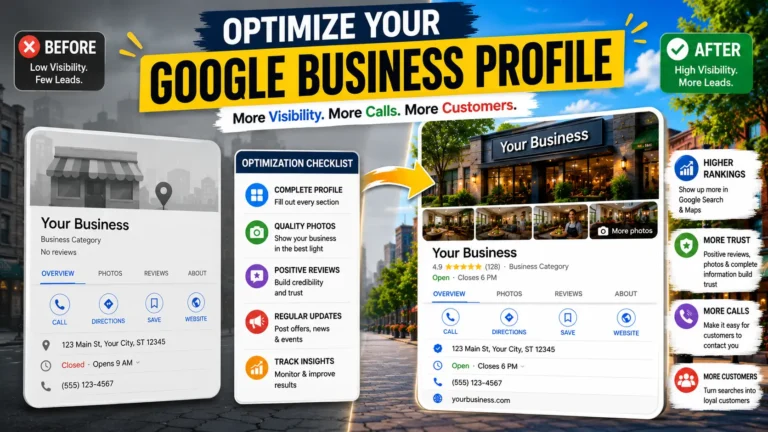
- Also ensure your Google Business Profile is fully optimized with
- Correct business information
- Updated hours
- Relevant categories
- Service descriptions
- Photos
- Accurate contact information
Even when proximity works against you geographically, strong local SEO signals can still improve your visibility and competitiveness.
Related Glossary Terms
Related glossary terms include:
- Local Ranking Factors
- Relevance
- Prominence
- Google Maps Ranking
- Local Pack
- Google Business Profile
Quick Action Checklist
- Set your service area correctly in Google Business Profile
- Focus on nearby customers and realistic service areas
- Strengthen relevance with clear service pages
- Build prominence through reviews and reputation
- Keep your business information accurate and consistent
- Optimize for Google Maps and Local Pack visibility