15 Local Ranking Factors That Get You More Calls
When potential customers search for services in their area, they rarely look past the first few results. Understanding the local ranking factors that dictate these top spots is essential for any business owner who relies on search engines for leads. In this article, we will explore the critical signals that determine which businesses receive the most calls and how you can optimize your online presence to capture that demand.
Key Google visibility signals influencing
Local SEO
Maps Rankings,
and Lead Generation
Why Local Ranking Factors Matter
Local visibility directly influences your call volume and overall lead flow. When your business appears in the Google Local Pack or at the top of Google Maps, you are positioned exactly where high-intent customers are looking. This prime real estate builds immediate trust and significantly increases the likelihood that a searcher will click to call or visit your website.
Without a strong local presence, your competitors will capture the majority of local inquiries. By mastering local ranking factors, you ensure that your business is the obvious choice when someone nearby needs your products or services.
How Google Determines Local Visibility
Google’s local search algorithm primarily relies on three core pillars: relevance, distance, and prominence. Relevance refers to how well a local Business Profile matches what someone is searching for. Distance considers how far each potential search result is from the location term used in a search, or from the user’s actual location if no term is specified.
Prominence is based on information that Google has about a business from across the web, like links, articles, and directories. It also factors in Google review count and review score. Understanding how these three elements interact is the foundation of any successful local SEO strategy.
15 Local Ranking Factors That Influence Who Gets the Most Calls
 1. Google Business Profile Primary Category
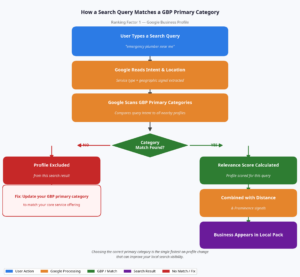
The primary category you select for your Google Business Profile is one of the strongest relevance signals you can provide. It tells Google exactly what your business is and matches you with broad search queries.
Choosing the most accurate and specific primary category ensures you appear for the right searches. If your category is too broad or incorrect, you will miss out on highly qualified traffic.
This factor directly affects calls because it determines if you even show up when a customer searches for your specific service. Being in the right category puts you in front of buyers ready to act.
This Flowchart shows how a search query matches a GBP primary category
 2. Keywords in Google Business Profile Title
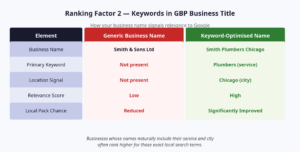
Having relevant keywords in your actual business name on your Google Business Profile is a known, powerful ranking factor. It provides a strong relevance signal to Google’s algorithm.
While you should never spam your title, businesses whose legal names naturally include their service and location often see a ranking boost. This helps them dominate local search results for those specific terms.
Higher rankings from keyword-rich titles lead to more visibility in the Local Pack, which translates directly to more phone calls from local searchers.
 3. Proximity of Address to the Point of Search
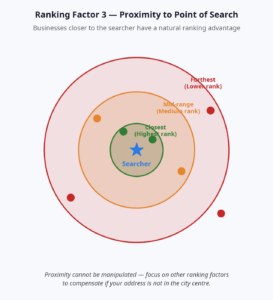
Proximity is the distance between the searcher’s physical location and your business address. It is a core component of Google’s local algorithm that you cannot easily manipulate.
Google wants to provide the most convenient options to its users. Therefore, businesses physically closer to the searcher have a natural advantage in local rankings.
Because users prefer convenience, ranking well due to proximity means you are highly likely to receive calls from people who are nearby and ready to visit or hire you immediately.
4. Physical Address in City of Search
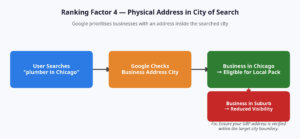
Having a physical address within the city limits of the user’s search query is a strong ranking signal. It establishes your business as a true local entity for that specific area.
If a user searches for “plumber in Chicago,” Google prioritizes businesses with a verified Chicago address over those in surrounding suburbs. This is a fundamental aspect of local relevance.
Ranking for city-specific searches drives high-volume, targeted traffic. Users searching with city modifiers are usually looking for immediate local solutions, leading to higher call conversion rates.
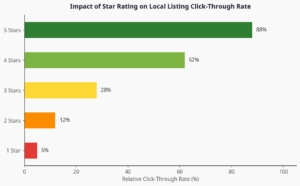 5. High Numerical Google Ratings (4.0-5.0)
Your overall star rating on Google is a major prominence signal. It reflects the quality of your business as perceived by your customers.
Google prefers to recommend highly-rated businesses to its users. A strong rating profile not only helps you rank higher but also makes your listing stand out visually in the search results.
Consumers heavily rely on reviews to make purchasing decisions. A high rating builds instant trust, making searchers much more likely to call you instead of a lower-rated competitor.
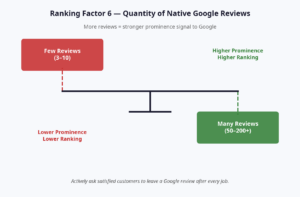
6. Quantity of Native Google Reviews
The total number of reviews your business has accumulated on Google is another critical prominence factor. It shows that your business is active, established, and frequently used by the community.
A high volume of reviews signals to Google that your business is popular and relevant. It helps validate your authority in your local market compared to competitors with fewer reviews.
More reviews provide more social proof. When potential customers see hundreds of reviews, they feel confident that calling your business is a safe and reliable choice.
7. Keywords in Native Google Reviews
When customers naturally include your target keywords (like specific services or locations) in their reviews, it reinforces your relevance for those terms.
Google scans review text to understand what a business is known for. Keyword-rich reviews act as user-generated content that validates your primary categories and services.
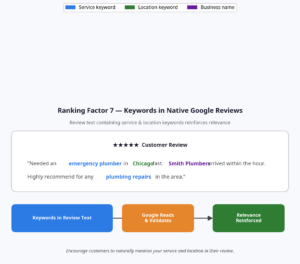
If a searcher sees reviews specifically mentioning the exact problem they need solved, they are highly motivated to call you, knowing you have successfully helped others with the same issue.
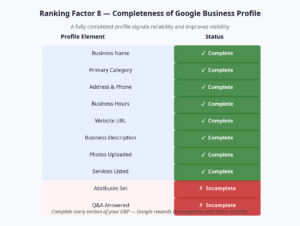 8. Completeness of Google Business Profile
A fully completed Google Business Profile provides Google with maximum information about your business. This includes hours, photos, attributes, and a detailed description.
Google favors profiles that offer a comprehensive user experience. Complete profiles are deemed more reliable and are therefore rewarded with better visibility in local searches.
A complete profile answers potential customers’ questions before they even ask. By providing all necessary details upfront, you remove friction and encourage them to make the call.
This image shows a checklist of elements for a complete Google Business Profile
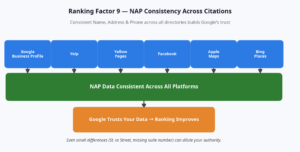
9. Consistency of NAP (Name, Address, Phone) Citations
NAP consistency refers to having your business Name, Address, and Phone number listed exactly the same way across the internet on various directories and websites.
Consistent citations build trust with Google’s algorithm. If your information varies across different sites, Google becomes less confident in your data and may lower your rankings.
Accurate information ensures that when a customer finds you on any platform, they can successfully contact you. Inconsistent phone numbers directly result in lost calls and frustrated leads.

10. Quality and Authority of Inbound Links
Backlinks from high-quality, authoritative websites to your local business website act as votes of confidence. They are a major prominence factor in traditional and local SEO.
Links from local news sites, industry associations, or chamber of commerce websites signal to Google that your business is a respected entity in your community and industry.
Higher authority leads to better overall organic rankings, which often pulls up your Maps rankings as well. This combined visibility maximizes the number of potential customers who see your phone number.
Diagram showing authoritative inbound links boosting local authority
11. Behavioral Signals (Click-Through Rate)
Behavioral signals include how often users click on your listing, call your business, or ask for directions after searching. These actions tell Google that users find your listing valuable.
A high click-through rate (CTR) indicates that your listing is relevant and appealing. Google rewards listings that users interact with by maintaining or improving their rank.
Optimizing your title, description, and reviews to improve CTR not only boosts rankings but directly increases the number of people viewing your contact information and making calls.

12. Mobile-Friendliness of Your Website
Since the majority of local searches are performed on mobile devices, having a mobile-friendly website is a crucial ranking factor. Google uses mobile-first indexing.
If your website is difficult to use on a smartphone, Google will rank it lower to protect the user experience. A responsive design is mandatory for local visibility.
A mobile-friendly site with a prominent “click-to-call” button makes it incredibly easy for mobile searchers to contact you instantly, directly driving up your call volume.

13. On-Page Location Keyword Optimization
Optimizing your website’s content, title tags, and meta descriptions with your city and service keywords helps Google connect your website to your local area.
Clear on-page local signals reinforce the relevance of your Google Business Profile. They confirm that your business actually serves the area you claim to serve.
When your website ranks well organically for local terms, it provides another avenue for customers to find you. Strong on-page SEO ensures your site captures leads who prefer to research before calling.

14. Recency of Google Reviews
Google values fresh content, and this applies to reviews as well. A steady stream of recent reviews shows that your business is currently active and consistently providing good service.
A profile with reviews from this week will often outrank a profile whose last review was two years ago, even if the older profile has a slightly higher overall rating.
Recent reviews reassure potential customers that your business is still operating at a high level today. This current social proof is highly persuasive in getting them to pick up the phone.

15. Presence of a Dedicated Contact Page
Having a clear, easily accessible contact page on your website with your NAP information and an embedded Google Map is a fundamental local SEO best practice.
This page provides a strong, unambiguous signal to Google about your physical location and contact details, reinforcing your local relevance.
From a user experience perspective, a dedicated contact page makes it effortless for visitors to find your phone number and reach out, directly facilitating more inquiries and calls.

Quick Reference Checklist
To maximize your local visibility and call volume, ensure you are addressing these core areas. Focus on your Google Business Profile, your website’s local signals, and building a strong reputation.

Common Mistakes That Reduce Local Visibility
Many businesses sabotage their own local rankings through simple errors. The most common mistake is inconsistent NAP information across different directories, which confuses Google and dilutes your authority. Another frequent issue is neglecting to choose the most specific primary category for their Google Business Profile.
Additionally, failing to actively manage and respond to reviews—both positive and negative—signals to Google and potential customers that you are not engaged. Finally, having a website that is slow or difficult to navigate on mobile devices will severely hurt your ability to rank and convert local traffic.
How Ranking Factors Fit Into a Larger Lead Generation Strategy
Local SEO is just one piece of the puzzle. While ranking factors drive organic visibility, they work best when integrated with a comprehensive lead generation strategy. For example, strong local SEO can reduce your reliance on paid advertising (PPC), but using both can help you dominate the search results page.
Furthermore, driving traffic through high rankings is useless if your website does not convert. Conversion rate optimization (CRO) ensures that the traffic generated by your local SEO efforts actually results in phone calls and form submissions.

Recommended Resource
Managing all these local ranking factors can be time-consuming. To streamline your efforts, track your rankings, and manage your citations effectively, we recommend using a dedicated local SEO tool.
Next Steps
Improving your local search visibility is an ongoing process. Start by auditing your current Google Business Profile and ensuring your NAP information is consistent across the web. Then, implement a strategy to consistently generate new, positive reviews from your satisfied customers.
Related Articles: