
SEM Manager
15 Local Ranking Factors That Get You More Calls
When potential customers search for services in their area, they rarely look past the first few results. Understanding the local ranking factors that dictate these top spots is essential for any business owner who relies on search engines for leads. In this article, we will explore the critical signals that determine which businesses receive the most calls and how you can optimize your online presence to capture that demand.
Key Google visibility signals influencing
Local SEO
Maps Rankings,
and Lead Generation
Why Local Ranking Factors Matter
Local visibility directly influences your call volume and overall lead flow. When your business appears in the Google Local Pack or at the top of Google Maps, you are positioned exactly where high-intent customers are looking. This prime real estate builds immediate trust and significantly increases the likelihood that a searcher will click to call or visit your website.
Without a strong local presence, your competitors will capture the majority of local inquiries. By mastering local ranking factors, you ensure that your business is the obvious choice when someone nearby needs your products or services.
How Google Determines Local Visibility
Google’s local search algorithm primarily relies on three core pillars: relevance, distance, and prominence. Relevance refers to how well a local Business Profile matches what someone is searching for. Distance considers how far each potential search result is from the location term used in a search, or from the user’s actual location if no term is specified.
Prominence is based on information that Google has about a business from across the web, like links, articles, and directories. It also factors in Google review count and review score. Understanding how these three elements interact is the foundation of any successful local SEO strategy.
15 Local Ranking Factors That Influence Who Gets the Most Calls
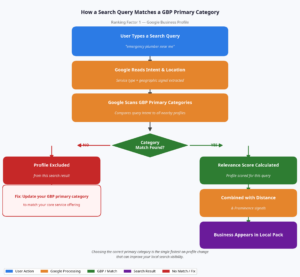 1. Google Business Profile Primary Category
The primary category you select for your Google Business Profile is one of the strongest relevance signals you can provide. It tells Google exactly what your business is and matches you with broad search queries.
Choosing the most accurate and specific primary category ensures you appear for the right searches. If your category is too broad or incorrect, you will miss out on highly qualified traffic.
This factor directly affects calls because it determines if you even show up when a customer searches for your specific service. Being in the right category puts you in front of buyers ready to act.
This Flowchart shows how a search query matches a GBP primary category
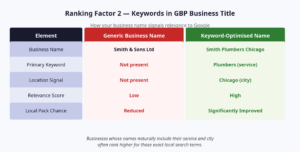 2. Keywords in Google Business Profile Title
Having relevant keywords in your actual business name on your Google Business Profile is a known, powerful ranking factor. It provides a strong relevance signal to Google’s algorithm.
While you should never spam your title, businesses whose legal names naturally include their service and location often see a ranking boost. This helps them dominate local search results for those specific terms.
Higher rankings from keyword-rich titles lead to more visibility in the Local Pack, which translates directly to more phone calls from local searchers.
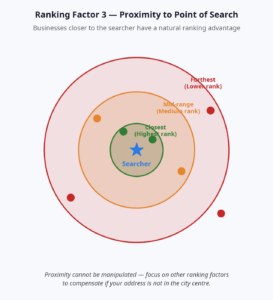 3. Proximity of Address to the Point of Search
Proximity is the distance between the searcher’s physical location and your business address. It is a core component of Google’s local algorithm that you cannot easily manipulate.
Google wants to provide the most convenient options to its users. Therefore, businesses physically closer to the searcher have a natural advantage in local rankings.
Because users prefer convenience, ranking well due to proximity means you are highly likely to receive calls from people who are nearby and ready to visit or hire you immediately.
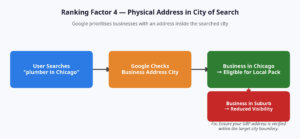
4. Physical Address in City of Search
Having a physical address within the city limits of the user’s search query is a strong ranking signal. It establishes your business as a true local entity for that specific area.
If a user searches for “plumber in Chicago,” Google prioritizes businesses with a verified Chicago address over those in surrounding suburbs. This is a fundamental aspect of local relevance.
Ranking for city-specific searches drives high-volume, targeted traffic. Users searching with city modifiers are usually looking for immediate local solutions, leading to higher call conversion rates.
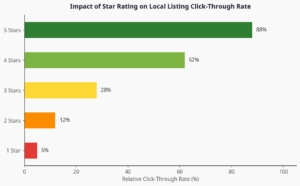 5. High Numerical Google Ratings (4.0-5.0)
Your overall star rating on Google is a major prominence signal. It reflects the quality of your business as perceived by your customers.
Google prefers to recommend highly-rated businesses to its users. A strong rating profile not only helps you rank higher but also makes your listing stand out visually in the search results.
Consumers heavily rely on reviews to make purchasing decisions. A high rating builds instant trust, making searchers much more likely to call you instead of a lower-rated competitor.
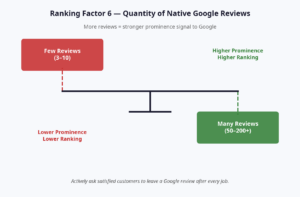
6. Quantity of Native Google Reviews
The total number of reviews your business has accumulated on Google is another critical prominence factor. It shows that your business is active, established, and frequently used by the community.
A high volume of reviews signals to Google that your business is popular and relevant. It helps validate your authority in your local market compared to competitors with fewer reviews.
More reviews provide more social proof. When potential customers see hundreds of reviews, they feel confident that calling your business is a safe and reliable choice.
7. Keywords in Native Google Reviews
When customers naturally include your target keywords (like specific services or locations) in their reviews, it reinforces your relevance for those terms.
Google scans review text to understand what a business is known for. Keyword-rich reviews act as user-generated content that validates your primary categories and services.
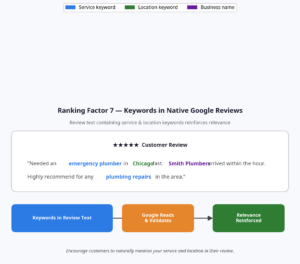
If a searcher sees reviews specifically mentioning the exact problem they need solved, they are highly motivated to call you, knowing you have successfully helped others with the same issue.
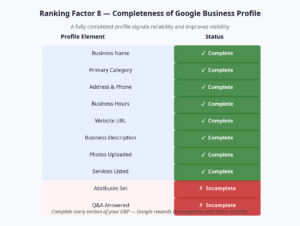 8. Completeness of Google Business Profile
A fully completed Google Business Profile provides Google with maximum information about your business. This includes hours, photos, attributes, and a detailed description.
Google favors profiles that offer a comprehensive user experience. Complete profiles are deemed more reliable and are therefore rewarded with better visibility in local searches.
A complete profile answers potential customers’ questions before they even ask. By providing all necessary details upfront, you remove friction and encourage them to make the call.
This image shows a checklist of elements for a complete Google Business Profile
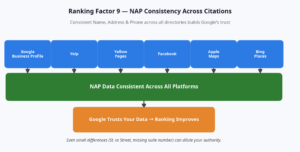
9. Consistency of NAP (Name, Address, Phone) Citations
NAP consistency refers to having your business Name, Address, and Phone number listed exactly the same way across the internet on various directories and websites.
Consistent citations build trust with Google’s algorithm. If your information varies across different sites, Google becomes less confident in your data and may lower your rankings.
Accurate information ensures that when a customer finds you on any platform, they can successfully contact you. Inconsistent phone numbers directly result in lost calls and frustrated leads.

10. Quality and Authority of Inbound Links
Backlinks from high-quality, authoritative websites to your local business website act as votes of confidence. They are a major prominence factor in traditional and local SEO.
Links from local news sites, industry associations, or chamber of commerce websites signal to Google that your business is a respected entity in your community and industry.
Higher authority leads to better overall organic rankings, which often pulls up your Maps rankings as well. This combined visibility maximizes the number of potential customers who see your phone number.
Diagram showing authoritative inbound links boosting local authority
11. Behavioral Signals (Click-Through Rate)
Behavioral signals include how often users click on your listing, call your business, or ask for directions after searching. These actions tell Google that users find your listing valuable.
A high click-through rate (CTR) indicates that your listing is relevant and appealing. Google rewards listings that users interact with by maintaining or improving their rank.
Optimizing your title, description, and reviews to improve CTR not only boosts rankings but directly increases the number of people viewing your contact information and making calls.

12. Mobile-Friendliness of Your Website
Since the majority of local searches are performed on mobile devices, having a mobile-friendly website is a crucial ranking factor. Google uses mobile-first indexing.
If your website is difficult to use on a smartphone, Google will rank it lower to protect the user experience. A responsive design is mandatory for local visibility.
A mobile-friendly site with a prominent “click-to-call” button makes it incredibly easy for mobile searchers to contact you instantly, directly driving up your call volume.

13. On-Page Location Keyword Optimization
Optimizing your website’s content, title tags, and meta descriptions with your city and service keywords helps Google connect your website to your local area.
Clear on-page local signals reinforce the relevance of your Google Business Profile. They confirm that your business actually serves the area you claim to serve.
When your website ranks well organically for local terms, it provides another avenue for customers to find you. Strong on-page SEO ensures your site captures leads who prefer to research before calling.

14. Recency of Google Reviews
Google values fresh content, and this applies to reviews as well. A steady stream of recent reviews shows that your business is currently active and consistently providing good service.
A profile with reviews from this week will often outrank a profile whose last review was two years ago, even if the older profile has a slightly higher overall rating.
Recent reviews reassure potential customers that your business is still operating at a high level today. This current social proof is highly persuasive in getting them to pick up the phone.

15. Presence of a Dedicated Contact Page
Having a clear, easily accessible contact page on your website with your NAP information and an embedded Google Map is a fundamental local SEO best practice.
This page provides a strong, unambiguous signal to Google about your physical location and contact details, reinforcing your local relevance.
From a user experience perspective, a dedicated contact page makes it effortless for visitors to find your phone number and reach out, directly facilitating more inquiries and calls.

Quick Reference Checklist
To maximize your local visibility and call volume, ensure you are addressing these core areas. Focus on your Google Business Profile, your website’s local signals, and building a strong reputation.

Common Mistakes That Reduce Local Visibility
Many businesses sabotage their own local rankings through simple errors. The most common mistake is inconsistent NAP information across different directories, which confuses Google and dilutes your authority. Another frequent issue is neglecting to choose the most specific primary category for their Google Business Profile.
Additionally, failing to actively manage and respond to reviews—both positive and negative—signals to Google and potential customers that you are not engaged. Finally, having a website that is slow or difficult to navigate on mobile devices will severely hurt your ability to rank and convert local traffic.
How Ranking Factors Fit Into a Larger Lead Generation Strategy
Local SEO is just one piece of the puzzle. While ranking factors drive organic visibility, they work best when integrated with a comprehensive lead generation strategy. For example, strong local SEO can reduce your reliance on paid advertising (PPC), but using both can help you dominate the search results page.
Furthermore, driving traffic through high rankings is useless if your website does not convert. Conversion rate optimization (CRO) ensures that the traffic generated by your local SEO efforts actually results in phone calls and form submissions.

Recommended Resource
Managing all these local ranking factors can be time-consuming. To streamline your efforts, track your rankings, and manage your citations effectively, we recommend using a dedicated local SEO tool.
Next Steps
Improving your local search visibility is an ongoing process. Start by auditing your current Google Business Profile and ensuring your NAP information is consistent across the web. Then, implement a strategy to consistently generate new, positive reviews from your satisfied customers.
Related Articles:
11 Google Changes That Could Quietly Reduce Local Leads in 2026
Recent Google algorithm updates and search layout changes affecting
local SEO rankings,
click-through rates,
and inbound lead volume
Listen to this article
Local businesses depend on search engines for consistent leads. When someone in your area needs a service, they pull out their phone and search. If your business appears at the top, your phone rings. If it doesn’t, your competitor gets the call. It’s that simple. However, search engine changes can influence visibility and customer inquiries in ways that are not always obvious.
Google frequently adjusts ranking signals and search layouts to improve the user experience. These adjustments, especially the google algorithm update 2026, mean that the strategies that worked last year might not keep your phone ringing today. Understanding these shifts is crucial for maintaining your local search visibility and protecting your inbound lead volume.
Overview
Algorithm changes are essentially updates to the complex mathematical formulas search engines use to decide which websites to show for a given search query. Search engines update ranking systems constantly to ensure they are providing the most relevant, high-quality, and helpful results to their users. They want to filter out spam, reward genuine expertise, and adapt to how people search, such as using voice commands or AI assistants.
These updates directly influence website visibility. When a google ranking update occurs, the criteria for what makes a “good” result shifts. A website that previously ranked number one might drop to page two if it no longer meets the new standards, while a competitor who aligns better with the new signals might rise to the top. This constant recalibration means that maintaining local search visibility requires ongoing attention and adaptation to the latest search engine changes 2026.
Why This Matters for Lead Generation
Search visibility connects directly to website traffic and inbound leads. The higher you appear in search results, the more likely potential customers are to click on your website or call your business directly from the search page. Most users never scroll past the first few results, making top placement critical for capturing local demand.
Ranking changes can significantly influence call volume and form submissions. If a google algorithm update 2026 pushes your business down in the local pack or organic results, the immediate effect is a drop in traffic. Fewer visitors mean fewer people filling out your contact forms or dialing your phone number. For a local business, this isn’t just a metric on a screen; it’s a direct impact on revenue and growth. Staying visible is synonymous with staying profitable.
11 Google Changes Affecting Local Leads
1. The Rise of AI-Powered Local Packs
Google is rolling out AI-powered local packs that often feature fewer businesses than the traditional 3-pack. This change reduces the overall number of businesses shown on the first page, increasing competition for those top spots. If your business isn’t selected by the AI, your local search visibility drops significantly. For example, a user searching for a local plumber might only see one or two AI-recommended options instead of three, meaning you have to work harder to be the absolute best answer.
2. Removal of Call Buttons in Search Results
Google has been testing the removal of direct call buttons from some mobile search results, replacing them with images or requiring users to click through to the profile first. This adds friction to the user journey, potentially reducing immediate inbound leads. A customer who previously tapped “call” right from the search page might now get distracted or choose a competitor whose contact info is easier to find.
3. Increased Prominence of Local Services Ads (LSAs)
Local Services Ads are taking up more real estate at the very top of the search results page. This pushes organic listings and the traditional local pack further down the screen. Even if your local SEO ranking factors are perfect, you might lose clicks to competitors paying for LSAs. A homeowner looking for an electrician will see the “Google Guaranteed” ads first, often clicking those before scrolling down to organic results.
4. Information Gain as a Primary Signal
The google algorithm update 2026 heavily rewards “information gain”—content that provides unique insights, original data, or first-hand experience not found elsewhere. If your website simply repeats what competitors say, your rankings will likely drop. A local roofer who publishes original case studies and photos of their specific projects will outrank one who uses generic, copied text about roofing materials.
5. Stricter E-E-A-T Requirements
Experience, Expertise, Authoritativeness, and Trustworthiness (E-E-A-T) are more critical than ever, especially for local businesses. Google wants proof that you are a real, reputable business. Lack of clear author credentials, poor reviews, or inconsistent business information can hurt your visibility. A local financial advisor without a detailed, verifiable biography on their site will struggle to rank against a competitor with strong, proven credentials.
6. Landmark-Based Navigation in Maps
Google Maps, powered by AI, is shifting towards landmark-based navigation (e.g., “turn right after the bank”). Businesses located near prominent landmarks may receive an unexpected boost in visibility and foot traffic. While you can’t easily move your business, understanding this helps explain shifts in local search visibility. A coffee shop next to a famous theater might see more foot traffic simply because the AI uses the theater as a reference point.
7. Decoupling of Page and Domain Authority
Google is increasingly evaluating individual pages on their own merit, rather than letting a strong domain protect weak content. This means low-quality pages on your site can drop in rankings, even if your homepage is strong. A local law firm with a highly authoritative homepage might still lose leads if their specific “personal injury” service page lacks depth and helpful information.
8. Enhanced Visual Search via Google Lens
Users are increasingly using Google Lens to point their cameras at storefronts to see reviews and information instantly. If your Google Business Profile lacks high-quality exterior photos or accurate attributes, you miss out on these visual searchers. A restaurant with great food but no updated storefront photos on Google might lose walk-in customers who use Lens to check the vibe before entering.
View the Full Interactive SEM Research Report →
9. Review Content and Context Matter More
It’s no longer just about the number of stars; Google’s algorithm now parses the actual text of reviews for specific services, locations, and sentiment. Generic reviews carry less weight than detailed ones. A landscaping company with reviews mentioning “great patio installation in downtown” will rank better for patio searches than a company with reviews that just say “good job.”
10. Precision in User Intent Matching
Google is getting better at understanding the “next question” a user might have. Pages that only answer a basic query without addressing follow-up needs are losing ground. If a user searches for “how to fix a leaky pipe,” a local plumber’s page that also explains when to call a professional will rank better than a page that only offers a DIY fix.
11. The Impact of AI Overviews on Informational Traffic
AI Overviews are answering user questions directly on the search page, reducing the need for users to click through to websites for basic information. This can decrease traffic to your blog posts. A local HVAC company might see less traffic to their “how often to change air filters” blog post because Google’s AI answers it directly, meaning they must focus more on capturing high-intent, service-ready leads.
Common Misunderstandings
A major misconception about algorithm updates is that they are penalties. When a google ranking update happens and your traffic drops, it doesn’t necessarily mean you did something wrong or broke a rule. It usually means Google has adjusted its criteria, and other pages are now deemed more relevant or helpful for those specific queries.
It is also important to understand that rankings may fluctuate naturally. Search results are dynamic. Competitors update their sites, new businesses open, and user search behavior changes. A slight drop in position one week might correct itself the next. It is crucial to look at long-term trends rather than panicking over daily google SERP changes.
Practical Takeaways
The key to surviving and thriving amidst search engine changes 2026 is adaptability. Focus on building a genuinely helpful, authoritative online presence rather than chasing short-term tricks. Ensure your Google Business Profile is comprehensive, encourage detailed customer reviews, and publish content that offers unique, first-hand value.
Awareness and monitoring are your best defences. Keep an eye on your inbound lead volume and website traffic. If you notice a sustained drop, investigate which pages or queries are affected. By staying informed about the latest google algorithm update 2026, you can proactively adjust your strategy and protect your local search visibility.
Related Topics
To build a comprehensive strategy, it is helpful to explore related areas. Mastering local SEO is the foundation, but integrating it with targeted Google Ads can provide immediate visibility while your organic rankings grow. Ultimately, all these efforts should tie back to effective lead generation and continuous conversion optimization to ensure the traffic you attract actually turns into paying customers.
Soft Transition to Tools
Navigating these constant shifts can feel overwhelming for a busy business owner. Fortunately, tools and structured processes can help monitor performance and identify opportunities. Utilizing analytics platforms, rank trackers, and review management software allows you to see exactly how your business is performing and where you need to focus your efforts to maintain a steady stream of local leads.
How Marketing Tools Help Plumbing Companies Improve Search Visibility
Search visibility determines whether a plumbing company consistently receives inbound calls or struggles with unpredictable lead flow. When homeowners search phrases like “emergency plumber near me” or “water heater repair Winnipeg”, search engines evaluate hundreds of signals to decide which companies appear at the top.
Marketing tools help plumbing companies influence those signals in a measurable, repeatable way. Instead of relying on guesswork, contractors can apply structured optimization processes that improve rankings, increase click-through rates, and ultimately generate more booked jobs.
This article explains which tools matter, how they improve search visibility, and how plumbing companies can implement them efficiently.
Why Search Visibility Matters for Plumbing Companies
Local service businesses operate in a high-intent environment. Most searches are performed by homeowners who are actively looking to solve a problem.
Common characteristics of plumbing-related searches:
- Urgent intent (“burst pipe repair”)
- Geographic modifiers (“plumber near me”)
- Mobile-first behavior
- High conversion probability
- Strong reliance on Google Maps results
Because of this intent profile, ranking improvements often translate directly into revenue increases.
Higher visibility typically leads to:
- More inbound calls
- More quote requests
- Lower cost per lead compared to traditional advertising
- Consistent job pipeline
Core Categories of Marketing Tools for Plumbers
Marketing tools fall into several functional categories. Each category targets a specific ranking factor within search algorithms.
1. Keyword Research Tools
Keyword tools help plumbing companies identify the exact search phrases potential customers use.
Examples of plumbing-related keyword themes:
- emergency plumbing repair
- drain cleaning services
- water heater installation
- sewer line repair
- leak detection
- commercial plumbing maintenance
Benefits:
- Identify high-intent keywords
- Understand search volume
- Evaluate ranking difficulty
- Discover long-tail variations
- Align content with user intent
Common tool functions include:
- search volume estimation
- keyword clustering
- competitor keyword discovery
- cost-per-click analysis
- trend tracking
Strategically selected keywords allow plumbing companies to build pages that match real search demand.
2. Local SEO Optimization Tools
Local SEO tools help plumbing companies improve visibility within map listings and localized search results.
Important ranking factors include:
- Google Business Profile optimization
- NAP consistency (Name, Address, Phone)
- proximity relevance
- review quantity and quality
- citation accuracy
Capabilities of local SEO tools:
- directory synchronization
- location audit reports
- duplicate listing detection
- citation building
- review monitoring
Local optimization is critical because map listings often appear above traditional organic results.
3. On-Page SEO Analysis Tools
On-page optimization tools analyze website structure and content quality.
They evaluate elements such as:
- title tags
- heading structure
- keyword placement
- internal linking
- image optimization
- page speed
- schema markup
- mobile usability
Technical improvements can significantly affect search rankings, especially in competitive local markets.
Many tools provide:
- content optimization suggestions
- technical error detection
- crawl diagnostics
- structured data validation
- duplicate content identification
4. Competitor Analysis Tools
Competitor research tools help plumbing companies understand what competing businesses are doing successfully.
Typical insights include:
- keywords competitors rank for
- backlink sources
- advertising strategies
- content gaps
- traffic estimates
This information allows companies to:
- identify ranking opportunities
- reverse-engineer successful strategies
- discover underserved keyword segments
- improve content positioning
Competitor intelligence reduces trial-and-error marketing decisions.
5. Lead Tracking and Analytics Tools
Analytics platforms measure how visitors interact with a plumbing website.
Key performance indicators include:
- traffic volume
- keyword rankings
- conversion rates
- call tracking metrics
- form submissions
- bounce rate
- user behavior flow
Data enables continuous optimization of marketing campaigns.
Tracking tools help identify:
- which keywords generate phone calls
- which pages convert best
- which traffic sources produce profitable customers
- where visitors exit the site
Without tracking, marketing improvements cannot be validated.
6. Review and Reputation Management Tools
Online reviews influence both rankings and customer trust.
Search engines evaluate:
- review frequency
- review sentiment
- response activity
- overall rating score
Review management tools assist with:
- requesting reviews automatically
- monitoring feedback
- responding efficiently
- identifying service issues
- improving public perception
A strong review profile increases click-through rates from search results.
7. Content Optimization Tools
Content tools help plumbing companies create useful information that answers common customer questions.
Examples of effective plumbing content topics:
- causes of low water pressure
- signs of hidden leaks
- cost factors for water heater replacement
- preventative plumbing maintenance tips
- emergency preparedness checklists
Content improves search visibility by:
- targeting informational queries
- building topical authority
- increasing site engagement
- generating backlinks
- expanding keyword coverage
Educational content often attracts visitors earlier in the decision process.
How Marketing Tools Work Together
Marketing tools are most effective when combined into a unified workflow.
Typical process:
Step 1: Keyword Discovery
Identify service-related search terms.
Step 2: Content Development
Create pages optimized for those keywords.
Step 3: Technical Optimization
Ensure website performance and structure meet search engine standards.
Step 4: Local Optimization
Improve map listing signals and citations.
Step 5: Reputation Building
Increase review volume and ratings.
Step 6: Performance Tracking
Measure rankings, traffic, and lead generation metrics.
Each stage reinforces the others.
Benefits of Using Marketing Tools for Plumbing SEO
When implemented correctly, marketing tools provide measurable advantages.
Increased visibility in local search results
Higher rankings produce more impressions and clicks.
More consistent lead flow
Search-driven leads often convert at higher rates than outbound advertising.
Improved return on marketing investment
Data-driven decisions reduce wasted ad spend.
Stronger competitive positioning
Companies using structured optimization often outperform competitors relying on outdated marketing tactics.
Scalable growth potential
Search visibility compounds over time as authority increases.
Implementation Considerations
Plumbing companies typically choose between:
- using individual tools independently
- using an integrated dashboard
- hiring an agency using professional tool stacks
- combining software with consulting support
Factors affecting tool selection:
- budget constraints
- technical expertise
- competition level in the service area
- desired growth rate
- available time for implementation
A simplified tool stack often produces better results than an overly complex system that is not fully utilized.
Conclusion
Marketing tools help plumbing companies improve search visibility by aligning website content, local listings, and technical performance with search engine ranking factors.
When properly implemented, these tools:
- increase website traffic
- generate qualified leads
- improve conversion rates
- reduce customer acquisition costs
- create long-term competitive advantages
Search visibility is not achieved through a single tactic. It results from consistent optimization across multiple ranking signals.
Marketing tools provide the structure and data needed to execute that optimization effectively.
Interesting Debate Topics For Students
Debate is more than just an academic exercise; it is a powerful tool for developing critical thinking, public speaking, research, and persuasive argumentation skills. For students, engaging in debate fosters intellectual curiosity, encourages a deeper understanding of complex issues, and builds confidence in expressing well-reasoned opinions. Choosing the right topic is paramount to a successful and engaging debate.
An interesting topic not only captivates the audience but also provides ample scope for research, diverse viewpoints, and robust discussion. This article aims to provide a comprehensive collection of interesting debate topics across various disciplines, offer guidance on selecting a topic that resonates, and highlight the benefits of participating in structured argumentation.
Education and Technology: Shaping the Future of Learning
The intersection of education and technology is a fertile ground for debate, constantly evolving and presenting new challenges and opportunities. These topics often touch upon pedagogical approaches, ethical considerations, and the very definition of learning in the 21st century.
- Should artificial intelligence (AI) be integrated into classroom learning?
- Pro-AI: AI can personalize learning paths, automate grading, provide instant feedback, and offer access to vast amounts of information, thereby enhancing educational outcomes and freeing up teachers for more individualized attention.
- Anti-AI: Over-reliance on AI could stifle critical thinking, reduce human interaction, create a digital divide, and raise concerns about data privacy and algorithmic bias.
- Is online learning as effective as traditional in-person education?
- Pro-Online: Online learning offers flexibility, accessibility, diverse resources, and can be more cost-effective, reaching students globally and accommodating various learning styles.
- Anti-Online: Lacks the social interaction of physical classrooms, can lead to isolation, requires high self-discipline, and may not be suitable for all subjects or learners.
- Should universities prioritize vocational training over liberal arts education?
- Pro-Vocational: Focuses on practical skills directly applicable to the job market, addressing immediate economic needs and reducing student debt by leading to quicker employment.
- Anti-Vocational: Liberal arts education fosters critical thinking, creativity, ethical reasoning, and adaptability, which are essential for long-term career success and responsible citizenship in a rapidly changing world.
- Should students be allowed to use smartphones in classrooms?
- Pro-Smartphones: Can be valuable learning tools for research, interactive apps, and quick access to information, enhancing engagement and preparing students for a tech-driven world.
- Anti-Smartphones: Lead to distractions, cyberbullying, cheating, and can hinder deep learning and face-to-face interaction.
- Should standardized testing be abolished?
- Pro-Abolition: Standardized tests create undue stress, promote rote memorization over genuine understanding, are culturally biased, and do not accurately reflect a student’s full capabilities.
- Anti-Abolition: Provide a consistent measure of student achievement, hold schools accountable, and can identify areas where students or schools need additional support.
These topics encourage students to think critically about the purpose and methods of education in a rapidly changing world, fostering discussions that are both timely and deeply relevant to their own experiences.
Society and Ethics: Navigating Complex Moral Dilemmas
Debates concerning society and ethics often delve into fundamental questions about justice, human rights, personal responsibility, and the role of government. These topics are excellent for developing moral reasoning and understanding diverse perspectives on contentious issues.
- Should social media companies be held responsible for the content posted on their platforms?
- Pro-Responsibility: Social media platforms have become powerful publishers and should be accountable for harmful content, misinformation, and hate speech, similar to traditional media outlets.
- Anti-Responsibility: Holding platforms liable could stifle free speech, be technically impossible to monitor all content, and turn platforms into censors, undermining their role as open forums.
- Is universal basic income (UBI) a viable solution to poverty and economic inequality?
- Pro-UBI: Could reduce poverty, improve public health, provide economic security, and stimulate local economies, offering a dignified safety net.
- Anti-UBI: Could disincentivize work, be fiscally unsustainable, lead to inflation, and might not address the root causes of poverty.
- Should genetic engineering of humans be permitted?
- Pro-Genetic Engineering: Could eradicate hereditary diseases, enhance human capabilities, and improve quality of life, offering solutions to previously incurable conditions.
- Anti-Genetic Engineering: Raises profound ethical concerns about designer babies, exacerbating social inequalities, unintended consequences, and playing God.
- Is privacy a fundamental human right in the digital age?
- Pro-Privacy: Individuals have a right to control their personal data, protect themselves from surveillance, and maintain autonomy over their digital lives, essential for freedom and democracy.
- Anti-Privacy: In a connected world, some degree of data sharing is necessary for security, public safety, and personalized services, arguing that absolute privacy is an outdated concept.
- Should animal testing for cosmetic products be banned globally?
- Pro-Ban: Animal testing is cruel, unnecessary due to alternative methods, and ethically indefensible, causing immense suffering for trivial purposes.
- Anti-Ban: Ensures product safety for human consumers, especially for novel ingredients, and alternatives may not fully replicate complex biological systems.
These topics challenge students to grapple with complex moral dilemmas, encouraging them to consider the broader societal implications of various policies and technological advancements.
Environment and Sustainability: Debating Our Planet’s Future
Environmental issues are among the most pressing challenges of our time, making them excellent subjects for debate. These topics often involve scientific understanding, economic considerations, and political will, providing a holistic view of global problems.
- Should nuclear energy be considered a sustainable energy source?
- Pro-Nuclear: Produces minimal greenhouse gas emissions, offers a reliable baseload power source, and has a small land footprint, crucial for combating climate change.
- Anti-Nuclear: Poses risks of catastrophic accidents, generates long-lived radioactive waste, is expensive to build, and raises security concerns.
- Is vegetarianism/veganism a moral imperative for environmental sustainability?
- Pro-Veganism: Animal agriculture is a major contributor to greenhouse gas emissions, deforestation, water pollution, and resource depletion, making plant-based diets essential for planetary health.
- Anti-Veganism: Sustainable and ethical animal farming practices exist, plant-based diets may not be nutritionally complete for everyone, and cultural traditions play a significant role in food choices.
- Should governments impose a carbon tax to combat climate change?
- Pro-Carbon Tax: Provides an economic incentive to reduce carbon emissions, encourages investment in green technologies, and generates revenue for environmental initiatives.
- Anti-Carbon Tax: Could disproportionately affect low-income households, harm economic competitiveness, and may not be effective without international cooperation.
- Is geoengineering a viable solution to climate change?
- Pro-Geoengineering: Could offer a rapid way to mitigate global warming, buying time for emissions reductions, and potentially reversing some climate impacts.
- Anti-Geoengineering: Carries significant risks of unintended side effects, could create new environmental problems, and might distract from the fundamental need to reduce emissions.
- Should single-use plastics be completely banned?
- Pro-Ban: Single-use plastics contribute massively to pollution, harm wildlife, and persist in the environment for centuries, necessitating a complete ban for ecological protection.
- Anti-Ban: Plastics offer convenience, hygiene, and affordability, and a complete ban could have economic repercussions and lead to less sustainable alternatives if not carefully managed.
These topics compel students to engage with scientific data, economic models, and ethical frameworks to propose and defend solutions to some of the world’s most complex environmental challenges.
Politics and Governance: Debating Public Policy and Justice
Debates on politics and governance often revolve around public policy, social justice, and the balance of power. These topics are excellent for developing an understanding of civic responsibility, legal frameworks, and the complexities of decision-making in a democratic society.
- Should voting be mandatory?
- Pro-Mandatory Voting: Increases voter turnout, ensures broader representation, legitimizes election results, and encourages civic engagement.
- Anti-Mandatory Voting: Infringes on individual liberty, could lead to uninformed votes, and may not genuinely increase political engagement.
- Should the voting age be lowered to 16?
- Pro-Lowering Age: Young people are affected by political decisions, are mature enough to vote, and lowering the age could increase political participation and youth engagement.
- Anti-Lowering Age: 16-year-olds may lack the life experience and political knowledge to make informed decisions, and their brains are still developing.
- Should governments regulate social media to combat misinformation?
- Pro-Regulation: Misinformation poses a threat to democracy, public health, and social cohesion, requiring government intervention to protect citizens and ensure factual discourse.
- Anti-Regulation: Government regulation could lead to censorship, stifle free speech, be politically biased, and be difficult to implement effectively without infringing on fundamental rights.
- Is capital punishment ever justifiable?
- Pro-Capital Punishment: Serves as a just retribution for heinous crimes, deters others, and ensures public safety by permanently removing dangerous offenders.
- Anti-Capital Punishment: Is irreversible in cases of wrongful conviction, is often applied disproportionately, does not deter crime more effectively than life imprisonment, and is a cruel and unusual punishment.
- Should there be stricter gun control laws?
- Pro-Stricter Control: Reduces gun violence, prevents mass shootings, and enhances public safety, arguing that the right to bear arms should not supersede the right to live safely.
- Anti-Stricter Control: Infringes on the Second Amendment right to bear arms, disarms law-abiding citizens, and may not deter criminals who will obtain weapons illegally regardless of laws.
These topics provide a platform for students to engage with real-world policy debates, encouraging them to research different viewpoints, articulate their positions, and understand the intricate balance between individual freedoms and collective well-being. Participating in such debates not only sharpens their argumentative skills but also cultivates informed and engaged citizens.
Hindi Essay And Hindi Speech Topics For Students
When it comes to public speaking or essay writing, especially in a language like Hindi, selecting the right topic is half the battle won. For students, the choice of topic can significantly influence their confidence, research depth, and overall performance. A well-chosen topic resonates with the audience, allows for a comprehensive exploration of ideas, and provides ample scope for creative expression. Conversely, a poorly selected topic can lead to a lack of engagement, superficial content, and a struggle to meet the required word count or presentation duration.
This article aims to guide students through the process of selecting compelling Hindi essay and speech topics. We will delve into various categories, offering a plethora of ideas that are not only relevant and interesting but also provide a solid foundation for research and articulation. The emphasis will be on topics that encourage critical thinking, foster a deeper understanding of cultural and social issues, and allow students to express their unique perspectives.
The Importance of Topic Selection
The significance of choosing an appropriate topic cannot be overstated. It acts as the cornerstone upon which the entire essay or speech is built. For an essay, a good topic ensures that the writer has enough material to elaborate on, preventing repetition and ensuring a logical flow of arguments. It also helps in structuring the essay effectively, from the introduction to the conclusion, with well-defined body paragraphs that support the central theme. Without a clear and engaging topic, an essay can quickly become disjointed and uninteresting.
Similarly, for a speech, the topic dictates the speaker’s ability to connect with the audience. A relevant and thought-provoking topic can capture attention from the outset, maintaining engagement throughout the presentation. It also empowers the speaker to deliver with conviction and passion, as they are discussing something they genuinely understand or care about. Furthermore, the right topic allows for the incorporation of anecdotes, examples, and rhetorical devices that can make a speech memorable and impactful. The selection process should therefore involve careful consideration of personal interest, audience demographics, available resources, and the overall objective of the assignment.
Factors to Consider When Choosing a Topic
Several factors come into play when making this crucial decision. Ignoring these can lead to challenges down the line, impacting the quality and effectiveness of the final output. Here are some key considerations:
- Personal Interest and Knowledge: Opting for a topic that genuinely interests you or one you already possess some knowledge about can make the research and writing process far more enjoyable and less daunting. Your enthusiasm will naturally translate into more engaging content.
- Audience Relevance: Consider who your audience will be. What are their interests, their age group, and their level of understanding? A topic that resonates with them will ensure better reception and engagement. For instance, a topic on environmental conservation might appeal to a broad student audience.
- Availability of Resources: Before finalizing a topic, conduct a preliminary search for information. Are there enough books, articles, or online resources available to support your arguments? A lack of credible sources can severely limit the depth of your essay or speech.
- Scope and Specificity: The topic should be neither too broad nor too narrow. A broad topic like “Climate Change” might be too vast for a single essay or speech, while “The Impact of Microplastics on Antarctic Krill” might be too specific without extensive research. Find a balance that allows for thorough exploration within the given constraints.
- Time Constraints: For speeches, consider the allotted time. A complex topic might require more time than available, leading to a rushed or incomplete presentation. Similarly, for essays, ensure the topic can be adequately covered within the word limit.
Popular Categories and Topic Ideas
To simplify the selection process, topics can be broadly categorized. This approach helps students narrow down their choices based on their interests and the subject matter they wish to explore. Below are some popular categories with example topics that are suitable for both essays and speeches in Hindi.
Social Issues
Social issues are always relevant and provide ample opportunities for students to express their opinions and suggest solutions. These topics often encourage empathy and critical thinking about the world around us.
| Category | Essay Topics (Hindi) | Speech Topics (Hindi) |
| Social Issues | पर्यावरण संरक्षण: हमारा कर्तव्य (Environmental Protection: Our Duty) | बेटी बचाओ, बेटी पढ़ाओ (Save Girl Child, Educate Girl Child) |
| भ्रष्टाचार: एक गंभीर समस्या (Corruption: A Serious Problem) | स्वच्छता अभियान: महत्व और चुनौतियाँ (Swachh Bharat Abhiyan: Importance and Challenges) | |
| महिला सशक्तिकरण (Women Empowerment) | शिक्षा का अधिकार (Right to Education) | |
| गरीबी उन्मूलन (Poverty Eradication) | डिजिटल इंडिया: सपने और हकीकत (Digital India: Dreams and Reality) | |
| बाल श्रम: एक अभिशाप (Child Labor: A Curse) | साइबर सुरक्षा: आज की आवश्यकता (Cyber Security: Need of the Hour) |
Cultural and Historical Topics
Exploring cultural and historical themes allows students to connect with their heritage and understand the evolution of society. These topics can be rich in narrative and offer insights into traditions, values, and significant events.
- भारत की विविधता में एकता (Unity in Diversity of India)
- भारतीय त्योहारों का महत्व (Importance of Indian Festivals)
- महात्मा गांधी का योगदान (Contribution of Mahatma Gandhi)
- प्राचीन भारतीय विज्ञान (Ancient Indian Science)
- भारतीय कला और संस्कृति (Indian Art and Culture)
- स्वतंत्रता संग्राम के गुमनाम नायक (Unsung Heroes of the Freedom Struggle)
Current Affairs and Technology
Staying updated with current affairs and technological advancements is crucial. These topics are dynamic and can spark engaging discussions, reflecting the fast-paced changes in the modern world.
- सोशल मीडिया का प्रभाव (Impact of Social Media)
- कृत्रिम बुद्धिमत्ता: भविष्य की दिशा (Artificial Intelligence: Direction of the Future)
- अंतरिक्ष अनुसंधान में भारत की उपलब्धियाँ (India’s Achievements in Space Research)
- जलवायु परिवर्तन और उसके प्रभाव (Climate Change and its Effects)
- डिजिटल भुगतान: सुविधा या खतरा (Digital Payments: Convenience or Threat)
- नई शिक्षा नीति (New Education Policy)
Inspirational and Moral Values
Topics centered around inspiration and moral values help students reflect on personal growth and ethical conduct. These can be particularly impactful for speeches, encouraging introspection and positive change.
- सत्य और अहिंसा का महत्व (Importance of Truth and Non-violence)
- कड़ी मेहनत सफलता की कुंजी है (Hard Work is the Key to Success)
- समय का सदुपयोग (Optimal Use of Time)
- ईमानदारी सबसे अच्छी नीति है (Honesty is the Best Policy)
- परोपकार का महत्व (Importance of Altruism)
- गुरु का महत्व (Importance of a Teacher)
Crafting Your Essay or Speech
Once a topic is selected, the next step is to craft the content. This involves thorough research, outlining, drafting, and refining. For essays, a clear structure with an introduction, body paragraphs, and a conclusion is essential. Each body paragraph should focus on a single idea, supported by evidence and examples. For speeches, engaging the audience from the start, maintaining eye contact, using appropriate body language, and varying vocal tone are crucial.
Tips for Effective Writing and Speaking
- Research Thoroughly: Gather information from multiple credible sources to ensure accuracy and depth. Organize your research notes to make the writing process smoother.
- Create an Outline: A detailed outline helps structure your thoughts and ensures a logical flow. For essays, this means planning your introduction, main arguments, supporting details, and conclusion. For speeches, it involves mapping out your opening, main points, and closing remarks.
- Draft and Revise: Write a first draft without worrying too much about perfection. Then, revise and edit for clarity, coherence, grammar, and spelling. Reading your work aloud can help identify awkward phrasing or grammatical errors.
- Practice for Speeches: Rehearse your speech multiple times. Practice in front of a mirror or a small audience to get comfortable with the delivery. Pay attention to your pace, pauses, and pronunciation.
- Use Simple Language: While it is important to use appropriate vocabulary, avoid overly complex sentences or jargon that might confuse your audience or reader. Clarity is key.
- Engage the Audience: For speeches, start with a hook to grab attention. Use rhetorical questions, anecdotes, or surprising statistics. For essays, a compelling opening statement can draw the reader in.
Conclusion
Choosing the right topic for a Hindi essay or speech is a foundational step towards success. It requires careful consideration of personal interest, audience, resources, and scope. By selecting a topic that is both engaging and manageable, students can embark on a journey of discovery, learning, and effective communication. The categories and ideas provided in this article serve as a starting point, encouraging students to explore, research, and articulate their thoughts with confidence and clarity. Remember, the goal is not just to complete an assignment, but to convey a message, share knowledge, and perhaps even inspire others. With thoughtful preparation and a well-chosen topic, every student has the potential to deliver a memorable essay or speech that leaves a lasting impression.
Growth Marketing Vs Performance Marketing Whats The Difference And Which One Is Right For You
**Introduction: Navigating the Marketing Landscape – Growth vs. Performance Marketing**
In the dynamic and ever-evolving world of digital business, marketing strategies are constantly adapting to new technologies, consumer behaviors, and competitive pressures. Among the myriad approaches, two terms frequently emerge as central to modern marketing efforts: growth marketing and performance marketing. While often used interchangeably, or seen as competing philosophies, they represent distinct yet complementary strategies, each with its own focus, methodologies, and objectives. Understanding the nuances between growth marketing and performance marketing is crucial for businesses looking to optimize their marketing spend, achieve sustainable expansion, and make informed decisions about where to allocate their resources. This article will dissect these two powerful marketing paradigms, clarifying their differences and guiding you towards determining which approach, or combination thereof, is best suited for your specific business goals.
The digital age has transformed marketing from a purely creative endeavor into a data-driven science. Both growth and performance marketing leverage analytics, experimentation, and optimization to drive results, yet their scope and strategic intent diverge significantly. Performance marketing typically zeroes in on immediate, measurable returns on investment, often through paid channels, while growth marketing adopts a broader, more holistic view, aiming for long-term, exponential business expansion across the entire customer lifecycle. The choice between prioritizing one over the other, or integrating both, depends heavily on a company’s stage of development, its financial resources, and its overarching strategic vision. A clear understanding of each will empower marketers and business leaders to craft more effective and impactful strategies.
This guide will delve into the core definitions, key characteristics, and operational differences between growth marketing and performance marketing. We will explore the typical channels and metrics associated with each, and critically evaluate their respective strengths and weaknesses. Finally, we will provide a framework for assessing your business needs and determining whether a performance-driven, growth-oriented, or hybrid approach will yield the most favorable outcomes. Our goal is to equip you with the knowledge to strategically navigate the complex marketing landscape, ensuring your efforts are not just effective, but also aligned with your long-term business objectives for sustainable success.
**Section 1: Defining the Disciplines – Growth Marketing and Performance Marketing**
While both growth and performance marketing are rooted in data and optimization, their fundamental definitions and strategic scopes set them apart.
**Performance Marketing:**
Definition: Performance marketing is an online marketing and advertising program in which advertisers pay marketing companies or publishers when specific actions are completed, such as a sale, a lead, a click, or an app install. It is heavily focused on measurable results and a clear return on investment (ROI).
Key Characteristics:
Measurable ROI: Every campaign is directly tied to a specific, quantifiable outcome.Paid Channels: Primarily utilizes paid advertising channels like search engine marketing (SEM), social media ads, display ads, and affiliate marketing.Short-Term Focus: Aims for immediate results and quick conversions.Optimization: Continuous A/B testing and optimization of campaigns to improve conversion rates and reduce cost per acquisition (CPA).Specific Metrics: Key performance indicators (KPIs) include CPA, ROI, ROAS (Return on Ad Spend), conversion rates, and click-through rates (CTR).
**Growth Marketing:**
Definition: Growth marketing is a holistic, experimental, and data-driven approach to marketing that focuses on optimizing the entire customer journey, from awareness and acquisition to retention and advocacy. It seeks sustainable, long-term growth for the entire business, not just specific campaigns.
Key Characteristics:
Full-Funnel Approach: Addresses all stages of the customer lifecycle (AARRR funnel: Acquisition, Activation, Retention, Revenue, Referral).Experimentation: Relies heavily on rapid experimentation, testing hypotheses across various channels and product features.Cross-Functional: Often involves collaboration between marketing, product, engineering, and sales teams.Long-Term Vision: Aims for compounding growth and sustainable business expansion.Broad Metrics: KPIs include customer lifetime value (CLTV), churn rate, user engagement, referral rates, and overall revenue growth.
While performance marketing is a subset of growth marketing, the latter encompasses a much wider strategic scope, integrating product development and customer experience into its core methodology.
|
Feature |
Performance Marketing |
Growth Marketing |
|
Primary Goal |
Immediate, measurable ROI (e.g., sales, leads) |
Sustainable, long-term business growth |
|
Focus Area |
Specific campaigns, paid channels |
Entire customer lifecycle (AARRR funnel) |
|
Time Horizon |
Short-term results |
Long-term, compounding growth |
|
Methodology |
Optimization, A/B testing of ads |
Rapid experimentation, cross-functional collaboration |
|
Key Channels |
SEM, Social Ads, Display, Affiliate |
SEO, Content, Email, Product, Referrals, Paid |
|
Key Metrics |
CPA, ROI, ROAS, Conversion Rate |
CLTV, Churn, Engagement, Referral Rate, Revenue |
**Section 2: Strengths, Weaknesses, and Typical Applications**
Both growth and performance marketing offer distinct advantages and disadvantages, making them suitable for different business contexts and objectives.
**Strengths and Weaknesses of Performance Marketing:**
Strengths:
Clear ROI: Easy to track and justify marketing spend with direct revenue attribution.Scalability: Campaigns can often be scaled up or down quickly based on performance.Immediate Results: Can generate leads and sales relatively quickly, ideal for short-term goals.Targeted Reach: Highly effective at reaching specific audiences with tailored messages.
Weaknesses:
Cost-Dependent: Requires continuous investment in paid channels; results often cease when spending stops.Limited Long-Term Impact: Less focus on brand building, customer loyalty, or organic growth.Ad Fatigue: Audiences can become desensitized to ads, leading to diminishing returns over time.Competitive Bidding: Can become expensive in highly competitive markets, driving up acquisition costs.
**Strengths and Weaknesses of Growth Marketing:**
Strengths:
Sustainable Growth: Focuses on building assets (e.g., content, product features, community) that drive organic, compounding growth.Customer-Centric: Optimizes the entire customer experience, leading to higher retention and CLTV.Innovation: Encourages continuous experimentation and discovery of new growth levers.Brand Building: Naturally contributes to stronger brand perception and loyalty over time.
Weaknesses:
Slower Initial Results: Experiments take time to yield significant data and insights.Complex to Implement: Requires cross-functional collaboration and a deep understanding of the entire customer journey.Requires Data Infrastructure: Needs robust analytics and tracking systems to identify growth opportunities.Less Direct ROI: Harder to attribute specific revenue gains to individual growth experiments compared to direct ad spend.
Performance marketing is often favored by startups needing quick traction or established businesses running specific promotional campaigns. Growth marketing is ideal for companies seeking long-term market dominance and a deep understanding of their customer base.
**Section 3: Which One is Right for You? Or Should You Combine Them?**
The decision of whether to prioritize growth marketing, performance marketing, or a hybrid approach depends heavily on your business stage, resources, and strategic objectives.
Consider performance marketing if:
You need immediate results: If your primary goal is to generate quick sales, leads, or app installs to meet short-term targets or validate a product.
You have a clear conversion funnel: Your customer journey from ad click to purchase is well-defined and optimized.
You have a budget for paid advertising: You are prepared to invest in paid channels and can closely monitor their ROI.
You are a new business: To gain initial traction, test market demand, and acquire early customers quickly.
Consider growth marketing if:
You seek sustainable, long-term expansion: Your goal is to build a robust, self-sustaining growth engine that compounds over time.
You want to optimize the entire customer lifecycle: You are focused on not just acquiring customers, but also activating, retaining, and turning them into advocates.
You are willing to experiment: You have a culture of testing hypotheses, learning from data, and iterating across different channels and product features.
You have cross-functional teams: Your marketing, product, and engineering teams can collaborate effectively to drive user experience improvements.
**The Hybrid Approach: The Power of Integration**
For many businesses, the most effective strategy is not to choose one over the other, but to integrate both. Performance marketing can provide the immediate fuel (leads, sales) that funds growth marketing initiatives, while growth marketing builds the long-term infrastructure (brand loyalty, organic channels, product improvements) that makes performance marketing more efficient and sustainable.
|
Business Stage |
Recommended Approach |
Rationale |
|
Startup (Early Stage) |
Performance-heavy with growth mindset |
Quick validation, early traction, then build sustainable loops |
|
Growth Stage |
Balanced Hybrid |
Leverage paid for scale, invest in retention, product, and organic channels |
|
Mature Business |
Growth-heavy with strategic performance |
Focus on innovation, customer loyalty, market expansion, use performance for specific campaigns |
|
Niche Market |
Growth-heavy (organic, referrals) |
Build strong community, leverage word-of-mouth, less reliance on expensive paid ads |
Ultimately, the best marketing strategy is one that is agile, data-driven, and aligned with your unique business objectives. By understanding the distinct strengths of growth and performance marketing, you can strategically deploy each to maximize your impact, drive sustainable success, and navigate the competitive digital landscape with confidence.
Good Presentation Topics
Introduction: The Art of Engagement – Unearthing Good Presentation Topics
In an era defined by information overload, the ability to deliver a compelling presentation is more valuable than ever. Whether in academic settings, professional conferences, or community gatherings, a well-chosen topic can transform a mundane monologue into an engaging dialogue, captivating an audience and leaving a lasting impression.
The challenge, however, often lies not in the delivery itself, but in the initial selection of a subject that is both interesting to the presenter and relevant to the audience. A truly good presentation topic sparks curiosity, invites discussion, and provides valuable insights, making the entire experience enriching for everyone involved. This article aims to guide you through the process of unearthing such topics, transforming the daunting task of topic selection into an exciting exploration of knowledge and communication.
The power of a presentation lies in its capacity to convey complex ideas, inspire action, or simply entertain. Yet, many presentations fall flat due to a lack of connection with the audience, often stemming from a topic that fails to resonate. The key to a successful presentation is finding that sweet spot where your passion intersects with your audience’s interests and the broader context of the event.
This requires not only a deep understanding of your subject matter but also an empathetic consideration of who you are speaking to and what they hope to gain. By focusing on topics that are timely, thought-provoking, or offer practical value, you can ensure your presentation stands out and achieves its intended impact.
This guide will explore the fundamental characteristics of a good presentation topic, offering strategies for brainstorming, refining, and tailoring your subject to different audiences and occasions. We will then provide a diverse range of topic ideas across various fields, designed to spark your imagination and help you identify subjects that are not only engaging but also allow you to showcase your expertise and passion.
Our goal is to equip you with the tools and confidence to select and deliver presentations that are not just informative, but truly memorable, fostering a deeper connection with your audience and elevating your communication skills to new heights.
Section 1: What Makes a Presentation Topic “Good”?
A good presentation topic is more than just an interesting subject; it possesses several key characteristics that contribute to its effectiveness and the overall success of your delivery.
Key characteristics of a good presentation topic:
Relevance to Audience: The topic should align with the interests, needs, or current concerns of your listeners. A topic that resonates with them will naturally capture their attention.
Personal Interest/Passion: Your genuine enthusiasm for the subject will be infectious. Choose something you are knowledgeable about and genuinely excited to discuss.
Clear Scope: The topic should be narrow enough to be covered adequately within the allotted time, but broad enough to offer sufficient depth and interesting points. Avoid topics that are too vast or too niche.
Timeliness/Currency: Topics that are current, address recent developments, or discuss emerging trends often generate more interest and engagement.
Value Proposition: The audience should gain something from your presentation – new knowledge, a different perspective, practical tips, or inspiration. What’s their takeaway?
Potential for Engagement: A good topic allows for interaction, questions, or a call to action. It should invite the audience to think, discuss, or even participate.
Originality/Fresh Perspective: While not always necessary, offering a unique angle or a fresh take on a familiar subject can make your presentation stand out.
By considering these elements during your topic selection process, you can significantly increase the likelihood of delivering a presentation that is both impactful and well-received.
| Characteristic | Why it Matters | Example |
| Relevance | Keeps audience engaged | Presenting ‘AI in Healthcare’ to medical professionals |
| Personal Interest | Boosts confidence and enthusiasm | Discussing a hobby you’re passionate about |
| Clear Scope | Ensures comprehensive coverage | ‘The Ethics of AI in Medical Diagnosis’ vs. ‘All About AI’ |
| Timeliness | Captures immediate attention | Discussing recent breakthroughs in renewable energy |
| Value Proposition | Provides audience with benefit | Offering practical tips for improving productivity |
| Engagement Potential | Fosters interaction | Posing a thought-provoking question for discussion |
Section 2: Diverse Topic Ideas for Various Contexts
To spark your imagination, here is a curated list of good presentation topics across different categories, suitable for various audiences and occasions. Remember to tailor these ideas to your specific context and expertise.
**For Academic & Educational Settings:**
The Future of Education: Personalized Learning and AI Tutors.
Ethical Implications of Gene Editing Technology.
The Psychology of Procrastination and How to Overcome It.
Understanding the Science Behind Climate Change Denial.
The Role of Indigenous Knowledge Systems in Modern Science.
**For Professional & Business Audiences:**
Leveraging Data Analytics for Strategic Business Decisions.
The Impact of Remote Work on Company Culture and Productivity.
Building a Resilient Supply Chain in a Globalized World.
The Power of Storytelling in Brand Marketing.
Navigating Cybersecurity Threats in the Digital Age.
**For Personal Development & Lifestyle:**
The Benefits of Mindfulness for Stress Reduction and Well-being.
Cultivating a Growth Mindset: Embracing Challenges for Personal Growth.
The Art of Digital Minimalism: Reclaiming Your Time and Attention.
Financial Literacy for Young Adults: Essential Skills for a Secure Future.
The Importance of Sleep: How Quality Rest Impacts Every Aspect of Your Life.
**For Technology & Innovation Enthusiasts:**
The Promise and Perils of Quantum Computing.
Exploring the Metaverse: Beyond Gaming to Real-World Applications.
The Evolution of Artificial Intelligence: From Narrow AI to AGI.
Blockchain Technology: Revolutionizing Industries Beyond Cryptocurrency.
Sustainable Technology: Innovations for a Greener Future.
When selecting from these ideas, consider what unique perspective or expertise you can bring to the table. Even a common topic can become extraordinary with a fresh approach.
Section 3: Tailoring Your Topic and Delivering with Impact
Once you have a potential topic, the next crucial steps involve tailoring it to your specific context and preparing for a delivery that leaves a lasting impression. A good topic is only half the battle; effective communication is the other.
Strategies for tailoring and delivering your presentation:
Know Your Audience: Research their background, interests, and what they expect to gain. Adjust your language, examples, and depth of content accordingly.
Define Your Core Message: What is the single most important idea you want your audience to remember? Build your entire presentation around this central theme.
Structure for Clarity: Use a clear, logical structure (e.g., problem-solution, chronological, compare-contrast). Start with an engaging hook, develop your points with evidence, and conclude with a strong summary and call to action.
Design Engaging Visuals: If using slides, keep them clean, visually appealing, and text-light. Use high-quality images, charts, and minimal text to support your points, not to read from.
Practice, Practice, Practice: Rehearse your presentation multiple times, ideally in front of a mirror or a small audience. Pay attention to timing, pacing, vocal variety, and body language.
Anticipate Questions: Think about potential questions your audience might ask and prepare concise, informed answers. This demonstrates expertise and confidence.
Connect Emotionally: Share personal anecdotes, use humor appropriately, or tell a story to create an emotional connection with your audience. People remember how you made them feel.
Be Authentic: Let your personality shine through. Authenticity builds trust and makes your presentation more relatable and memorable.
A good presentation topic, combined with thoughtful preparation and confident delivery, can transform a simple talk into a powerful experience. By focusing on relevance, engagement, and value, you can ensure your message not only reaches your audience but also resonates deeply, inspiring thought, discussion, and action long after you’ve finished speaking.
English Speech Topics
Public speaking is a fundamental skill that transcends academic and professional boundaries, empowering individuals to articulate their thoughts, persuade audiences, and inspire action. For students, the opportunity to deliver a speech in English is not just an academic exercise but a crucial step in developing confidence, refining communication abilities, and mastering a global language. The success of any speech, however, often begins with the selection of a compelling topic. A well-chosen topic not only resonates with the audience but also provides the speaker with a solid foundation for research, content development, and a passionate delivery.
This article aims to provide a comprehensive guide to selecting engaging and impactful English speech topics for students across various educational levels. We will explore diverse categories, offering a plethora of ideas that are not only relevant and interesting but also provide ample scope for research, critical thinking, and eloquent expression. The emphasis will be on topics that encourage students to explore contemporary issues, delve into personal experiences, and articulate their unique perspectives with clarity and conviction. The goal is to inspire speeches that are informative, persuasive, and memorable, fostering a deeper appreciation for the art of public speaking.
The Cornerstone of Effective Communication: Topic Selection
The choice of a speech topic is the bedrock upon which the entire presentation is built. It is the initial spark that ignites the research process, shapes the narrative, and ultimately determines the audience’s engagement. A topic that genuinely interests the speaker translates into a more enthusiastic and authentic delivery, making the content more relatable and impactful for the listeners. This personal connection is often what distinguishes a good speech from a truly great one.
Furthermore, a well-defined topic provides a clear roadmap for structuring the speech, ensuring a logical flow of ideas from the introduction to the conclusion. It helps in organizing arguments, supporting them with evidence, and crafting a coherent message that is easy for the audience to follow. Conversely, a vague or uninteresting topic can lead to a disjointed presentation, a lack of audience engagement, and a struggle to meet the speech’s objectives. Therefore, dedicating sufficient time and thought to topic selection is a foundational step towards achieving public speaking excellence.
Essential Criteria for Choosing a Speech Topic
Several critical factors should be considered when selecting an English speech topic. These considerations ensure that the chosen topic is not only engaging but also manageable and appropriate for the context.
- Audience Relevance: The topic should resonate with your specific audience. Consider their age, background, interests, and prior knowledge. A topic that connects with their experiences or addresses their concerns will ensure better reception.
- Personal Interest and Knowledge: Opt for a topic that genuinely interests you or one you already possess some knowledge about. Your passion will naturally shine through, making the research and delivery process more enjoyable and authentic.
- Availability of Resources: Before finalizing a topic, conduct a preliminary search for information. Are there enough credible sources, such as books, academic articles, reputable websites, or expert interviews, available to support your arguments?
- Scope and Specificity: The topic should be neither too broad nor too narrow. A broad topic might lead to superficial coverage, while a too-narrow topic might lack sufficient material. Find a balance that allows for thorough exploration within the given time constraints.
- Purpose of the Speech: Is the speech meant to inform, persuade, entertain, or inspire? The purpose will guide your topic choice and the way you structure your arguments and present your information.
- Time Constraints: Be mindful of the allotted time for your speech. A complex topic might require more time than available, leading to a rushed or incomplete presentation. Choose a topic that can be adequately covered within the given duration.
Diverse Categories and Topic Ideas for English Speeches
To simplify the selection process, topics can be broadly categorized. This approach helps students narrow down their choices based on their interests, academic discipline, and the subject matter they wish to explore. Below are some diverse categories with example topics that are suitable for engaging English speeches.
Contemporary Social Issues
These topics delve into current societal challenges and debates, providing opportunities for critical analysis, ethical discussions, and proposals for solutions. They often encourage empathy and a deeper understanding of the world.
|
Category |
English Speech Topic Ideas |
|
Environment |
The Urgency of Climate Action: Our Collective Responsibility |
|
Plastic Pollution: A Global Crisis and Sustainable Solutions |
|
|
The Importance of Renewable Energy for a Greener Future |
|
|
Technology |
The Impact of Artificial Intelligence on Society |
|
Social Media: Connecting or Dividing Us? |
|
|
Cybersecurity in the Digital Age: Protecting Our Data |
|
|
Human Rights |
Gender Equality: Progress and Persistent Challenges |
|
The Fight Against Poverty: Global Efforts and Local Initiatives |
|
|
Freedom of Speech: Its Importance and Limitations |
Education and Personal Development
Topics in this category focus on learning, growth, and the skills necessary for personal and academic success. They often resonate deeply with students and can be highly motivational.
- The Future of Education: Online Learning vs. Traditional Classrooms
- The Importance of Critical Thinking in the Modern World
- Developing Emotional Intelligence: A Key to Success
- The Benefits of Reading for Personal Growth
- Overcoming Procrastination: Strategies for Students
- The Role of Extracurricular Activities in Holistic Development
Science and Innovation
This category explores scientific discoveries, technological breakthroughs, and their implications for humanity. These topics can be highly engaging, showcasing the wonders of the natural world and human ingenuity.
- Space Exploration: Humanity’s Next Frontier
- The Mysteries of the Human Brain: Unlocking Its Potential
- Genetic Engineering: Promises and Ethical Dilemmas
- The Science Behind Dreams: Why We Dream
- Renewable Energy Technologies: Powering the Future
- The Evolution of Communication: From Smoke Signals to Smartphones
Culture and Arts
These topics delve into the rich tapestry of human expression, traditions, and creativity. They offer opportunities to explore diverse cultures, artistic movements, and the power of creative expression.
- The Influence of Music on Culture and Society
- The Importance of Preserving Indigenous Languages
- Street Art: Vandalism or Valid Art Form?
- The Role of Literature in Shaping Our Understanding of the World
- Cultural Festivals: Celebrating Diversity and Unity
- The Evolution of Fashion: A Reflection of Society
Crafting and Delivering an Effective English Speech
Once a compelling topic is chosen, the next crucial step is to craft and deliver a speech that is both informative and engaging. This involves meticulous preparation, thoughtful structuring, and confident delivery.
Tips for a Stellar Speech
- Strong Opening: Begin with a captivating hook to immediately grab your audience’s attention. This could be a surprising statistic, a rhetorical question, a short anecdote, or a bold statement related to your topic.
- Clear Structure: Organize your speech with a clear introduction, body paragraphs, and a conclusion. Each section should flow logically into the next, guiding the audience through your message.
- Concise Language: Use clear, simple, and direct language. Avoid jargon or overly complex sentences that might confuse your audience. Every word should contribute to your message.
- Engage with Your Audience: Maintain eye contact, use appropriate body language, and vary your vocal tone and pace. These elements help in connecting with your audience and keeping them engaged.
- Visual Aids (If Applicable): If using visual aids like slides, ensure they are clean, concise, and complement your spoken words. They should enhance, not distract from, your message.
- Practice, Practice, Practice: Rehearse your speech multiple times. This helps you become familiar with the content, manage your time effectively, and deliver with confidence and fluency. Practice in front of a mirror or a small audience.
- Memorable Conclusion: End with a powerful summary of your main points, a call to action, or a thought-provoking statement that leaves a lasting impression on your audience.
Conclusion
Selecting the right English speech topic is a foundational step towards delivering a successful and impactful presentation. It empowers students to explore subjects they are passionate about, fostering deeper learning and more confident communication. By considering factors like audience relevance, personal interest, resource availability, and the purpose of the speech, and by drawing from diverse categories such as social issues, education, science, and culture, students can find topics that truly resonate. Coupled with effective structuring, compelling delivery, and thorough preparation, a well-chosen topic transforms a speech from a mere assignment into an opportunity to inform, persuade, and inspire an audience. The ideas presented here are designed to be a springboard, encouraging students to think creatively and speak with impact, ultimately enhancing their academic journey and future professional endeavors.
Engaging Presentation Topics Ideas Students
Delivering a presentation can be a daunting task for many students, but the right topic can transform it into an exciting opportunity for learning and sharing. An engaging presentation topic not only captures the audience’s attention but also allows the presenter to explore a subject they are passionate about, leading to a more confident and impactful delivery. The challenge often lies in moving beyond conventional subjects to find ideas that are fresh, thought-provoking, and offer scope for creativity.
This article aims to provide students with a diverse range of engaging presentation topic ideas, designed to spark interest and encourage deeper exploration. We will cover various fields, from technology and science to social issues and personal development, ensuring there is something for every student’s interest. The goal is to inspire presentations that are not just informative but also memorable, fostering a dynamic learning environment where ideas are exchanged and perspectives are broadened.
The Power of a Captivating Topic
The foundation of any successful presentation is its topic. A captivating topic serves as a magnet, drawing the audience in and holding their attention throughout the delivery. It sets the tone for the entire presentation, influencing the research process, the visual aids chosen, and the overall narrative. When a topic genuinely interests the presenter, their enthusiasm becomes infectious, making the content more relatable and enjoyable for the audience.
Moreover, a well-chosen topic provides a clear direction for research and content development. It helps in structuring the presentation logically, ensuring a coherent flow of information from the introduction to the conclusion. Without a compelling topic, a presentation can feel disjointed, lacking a central theme to tie everything together. This can lead to a loss of audience engagement and a less effective communication of ideas. Therefore, investing time in selecting an engaging topic is a critical step towards a successful presentation.
Key Elements of an Engaging Topic
To ensure a topic is truly engaging, it should possess certain characteristics. These elements contribute to both the presenter’s confidence and the audience’s reception.
- Relevance: The topic should be relevant to the audience’s interests or current events. A topic that addresses contemporary issues or offers practical insights is more likely to resonate.
- Novelty: While familiar topics can be engaging, a fresh perspective or an unexplored aspect of a known subject can make a presentation stand out. Think about unique angles or recent developments.
- Controversy or Debate: Topics that invite discussion or present differing viewpoints can be highly engaging. They encourage critical thinking and active participation from the audience, making the presentation interactive.
- Personal Connection: If the presenter has a personal connection to the topic, it often translates into a more passionate and authentic delivery. Sharing personal experiences or insights can make the content more relatable.
- Visual Potential: Consider if the topic lends itself well to visual aids. Presentations are enhanced by compelling images, videos, or infographics that help illustrate complex ideas and keep the audience visually stimulated.
Diverse Categories for Presentation Topics
To assist students in finding their ideal topic, we have categorized ideas across various disciplines. This structured approach allows for easier navigation and selection based on individual preferences and academic requirements.
Technology and Innovation
Technology is a rapidly evolving field, offering a wealth of topics that are both current and futuristic. These ideas can explore advancements, ethical implications, or societal impacts.
|
Category |
Presentation Topic Ideas |
|
Technology |
The Future of Artificial Intelligence: Beyond Sci-Fi |
|
Cybersecurity in the Digital Age: Protecting Your Privacy |
|
|
The Impact of Social Media on Mental Health |
|
|
Renewable Energy Technologies: Powering a Sustainable Future |
|
|
Virtual Reality and Augmented Reality: Transforming Industries |
|
|
The Ethics of Gene Editing: A Brave New World? |
Science and Environment
Topics in science and environment encourage exploration of the natural world, scientific discoveries, and pressing ecological concerns. These can range from biological wonders to climate solutions.
- The Mysteries of the Deep Sea: Unveiling Unknown Ecosystems
- Climate Change Solutions: Innovations and Global Efforts
- The Human Brain: Unlocking Its Full Potential
- Biodiversity Loss: Causes, Consequences, and Conservation
- Space Exploration: Humanity’s Next Frontier
- The Science Behind Sleep: Why We Need It
Social Issues and Humanities
These topics delve into human society, culture, history, and contemporary challenges. They provide opportunities for critical analysis, empathy, and discussions on societal improvements.
- The Role of Education in Poverty Alleviation
- Understanding Global Migration: Challenges and Opportunities
- The Evolution of Human Rights: A Historical Perspective
- Media Literacy in the Age of Misinformation
- The Power of Storytelling: Shaping Cultures and Identities
- Addressing Homelessness: Community Solutions and Support
Personal Development and Life Skills
Topics in this category focus on self-improvement, psychological well-being, and practical skills that are valuable in everyday life. They often resonate deeply with students seeking personal growth.
- The Importance of Emotional Intelligence in Leadership
- Mindfulness and Stress Management Techniques for Students
- Building Resilience: Overcoming Adversity
- Effective Time Management Strategies for Academic Success
- The Art of Public Speaking: Conquering Stage Fright
- Financial Literacy for Young Adults: Planning Your Future
Structuring Your Engaging Presentation
Once an engaging topic is chosen, the next step is to structure the presentation effectively. A well-organized presentation ensures that the audience can follow your arguments and absorb the information presented. This involves a clear introduction, well-developed body, and a strong conclusion.
Tips for a Stellar Presentation
- Start with a Hook: Begin your presentation with something that immediately grabs attention. This could be a surprising statistic, a thought-provoking question, a short anecdote, or a compelling visual.
- Clear Objectives: Clearly state what you intend to cover and what the audience should expect to learn. This sets expectations and provides a roadmap for your presentation.
- Logical Flow: Organize your content into logical sections. Use transitions to smoothly move from one point to the next, ensuring coherence and preventing abrupt shifts in topic.
- Visual Aids: Utilize slides, images, videos, and other visual aids to enhance your message. Keep slides clean, concise, and visually appealing. Avoid overcrowding them with text.
- Engage Your Audience: Encourage participation through questions, polls, or interactive activities. Maintain eye contact, use appropriate body language, and vary your vocal tone to keep the audience engaged.
- Practice, Practice, Practice: Rehearse your presentation multiple times. This helps you become familiar with the content, manage your time effectively, and deliver with confidence and fluency.
- Strong Conclusion: Summarize your main points and reiterate your key message. End with a memorable statement, a call to action, or a thought-provoking question that leaves a lasting impression.
Conclusion
Selecting an engaging presentation topic is a pivotal step towards delivering a successful and memorable presentation. It empowers students to explore subjects they are passionate about, fostering deeper learning and more confident communication. By considering factors like relevance, novelty, and visual potential, and by drawing from diverse categories such as technology, science, social issues, and personal development, students can find topics that truly resonate. Coupled with effective structuring and delivery techniques, an engaging topic transforms a presentation from a mere assignment into an opportunity to inspire, inform, and connect with an audience. The ideas presented here are designed to be a springboard, encouraging students to think creatively and present with impact.
Digital Marketing Vs Performance Marketing
**Introduction: Decoding Modern Marketing – Digital Marketing vs. Performance Marketing**
In the vast and ever-evolving landscape of contemporary business, marketing strategies are continuously adapting to new technologies, consumer behaviors, and competitive pressures. Two terms that frequently appear in discussions about modern marketing are “digital marketing” and “performance marketing.” While they are closely related and often overlap, they are not interchangeable. Understanding the distinct characteristics, objectives, and methodologies of each is crucial for businesses aiming to effectively reach their target audiences, optimize their marketing spend, and achieve measurable results. This article will delve into the nuances between digital marketing and performance marketing, clarifying their differences and guiding you towards determining the most effective approach for your specific business goals.
The advent of the internet and digital technologies has revolutionized how businesses connect with customers, giving rise to digital marketing as an umbrella term for all marketing efforts that use an electronic device or the internet. Performance marketing, on the other hand, is a more specialized subset of digital marketing, characterized by its focus on measurable outcomes and a pay-for-performance model. The distinction is not merely semantic; it represents different strategic priorities and operational approaches. A clear understanding of these differences will empower marketers and business leaders to craft more precise, impactful, and ROI-driven strategies, ensuring that every marketing dollar is spent wisely and effectively.
This guide will explore the core definitions, key characteristics, and operational differences between digital marketing and performance marketing. We will examine the typical channels, metrics, and strategic goals associated with each, and critically evaluate their respective strengths and weaknesses. Finally, we will provide a framework for assessing your business needs and determining whether a broad digital marketing strategy, a focused performance marketing approach, or a synergistic combination of both will yield the most favorable outcomes. Our goal is to equip you with the knowledge to strategically navigate the complex marketing landscape, ensuring your efforts are not just effective, but also aligned with your long-term business objectives for sustainable success.
**Section 1: Defining the Domains – Digital Marketing and Performance Marketing**
To understand the relationship between digital marketing and performance marketing, it is essential to establish clear definitions for each.
**Digital Marketing:**
Definition: Digital marketing encompasses all marketing efforts that use an electronic device or the internet. Businesses leverage digital channels such as search engines, social media, email, and other websites to connect with current and prospective customers. It is a broad term that includes a wide array of strategies aimed at building brand awareness, engaging audiences, and driving various business objectives.
Key Characteristics:
Broad Scope: Covers all online marketing activities, regardless of whether they are directly tied to a measurable action or not.Brand Building: Often focuses on increasing brand visibility, recognition, and fostering customer loyalty over time.Diverse Channels: Utilizes a wide range of online channels, including organic search (SEO), content marketing, social media marketing (organic), email marketing, and paid advertising.Varied Objectives: Goals can include brand awareness, customer engagement, lead generation, sales, customer retention, and thought leadership.Long-Term and Short-Term: Can pursue both immediate results and long-term strategic goals.
**Performance Marketing:**
Definition: Performance marketing is a subset of digital marketing where advertisers pay marketing companies or publishers only when specific, measurable actions are completed. These actions can include a sale, a lead, a click, an app install, or a form submission. It is characterized by its results-oriented, pay-for-performance model.
Key Characteristics:
Measurable ROI: Every campaign is directly tied to a specific, quantifiable outcome, making ROI easily trackable.Paid Channels: Primarily utilizes paid advertising channels like search engine marketing (SEM), social media ads, display ads, native advertising, and affiliate marketing.Short-Term Focus: Aims for immediate results and quick conversions, often with a clear cost-per-action (CPA) target.Optimization: Continuous A/B testing and optimization of campaigns to improve conversion rates and reduce CPA.Specific Metrics: Key performance indicators (KPIs) include CPA, ROI, ROAS (Return on Ad Spend), conversion rates, and click-through rates (CTR).
In essence, all performance marketing is digital marketing, but not all digital marketing is performance marketing. Digital marketing is the broader category, while performance marketing is a specific, results-driven approach within it.
|
Feature |
Digital Marketing |
Performance Marketing |
|
Scope |
Broad umbrella of all online marketing |
Subset of digital marketing, results-driven |
|
Payment Model |
Various (fixed fees, retainers, etc.) |
Pay-for-performance (CPA, CPL, CPC) |
|
Primary Goal |
Brand awareness, engagement, leads, sales |
Immediate, measurable ROI (sales, leads, clicks) |
|
Focus Area |
Entire customer journey, brand building |
Specific conversion events |
|
Channels (Examples) |
SEO, Content, Social (organic), Email, Paid Ads |
SEM, Social Ads, Display Ads, Affiliate, Native Ads |
|
Key Metrics |
Website traffic, engagement, brand mentions, leads, sales |
CPA, ROI, ROAS, Conversion Rate, CTR |
**Section 2: Strategic Objectives and Operational Differences**
The divergence between digital marketing and performance marketing becomes clearer when examining their strategic objectives and how they operate in practice.
**Strategic Objectives:**
Digital Marketing: Aims for a holistic impact on the brand and customer relationship. Objectives can include increasing brand recognition, establishing thought leadership, fostering community engagement, driving organic traffic, and nurturing leads over time. It often plays a crucial role in the upper and middle parts of the marketing funnel.
Performance Marketing: Primarily focused on driving specific, quantifiable actions that directly contribute to revenue or lead generation. Its objectives are typically centered around the lower part of the marketing funnel, aiming for conversions and immediate returns. The success of performance marketing is directly tied to its ability to generate a positive ROI on ad spend.
**Operational Differences:**
Budget Allocation: In digital marketing, budgets might be allocated across a wider range of activities, some of which (like content creation or SEO) may not have immediate, direct ROI. In performance marketing, budgets are typically tied directly to campaign performance, with spending adjusted based on real-time results.
Experimentation: Both involve experimentation, but with different focuses. Digital marketing might experiment with new content formats or social media strategies for engagement. Performance marketing rigorously A/B tests ad creatives, landing pages, and bidding strategies to optimize conversion rates.
Team Structure: Digital marketing teams often include content creators, SEO specialists, social media managers, and email marketers. Performance marketing teams are typically composed of media buyers, data analysts, and conversion rate optimization (CRO) specialists.
Reporting and Analytics: Digital marketing reports might include metrics like website traffic, bounce rate, time on page, social media reach, and email open rates. Performance marketing reports are laser-focused on conversion metrics, cost per acquisition, and return on ad spend.
These operational distinctions highlight how each approach is designed to achieve different, albeit complementary, business outcomes.
**Section 3: Which Approach is Right for Your Business?**
The choice between prioritizing digital marketing, performance marketing, or a combined strategy depends on your business goals, stage, budget, and industry.
**When to prioritize Digital Marketing (broader approach):**
Brand Building: If your primary goal is to establish a strong brand identity, increase brand awareness, and build long-term customer loyalty.
Content and SEO: If you aim to become a thought leader in your industry, attract organic traffic, and provide value through informative content.
Customer Engagement: If fostering a community, building relationships, and nurturing leads over an extended period are key objectives.
Long-Term Strategy: If you are looking for sustainable growth that may not yield immediate, direct revenue but builds foundational assets for the future.
**When to prioritize Performance Marketing (results-driven approach):**
Immediate Conversions: If your main objective is to drive quick sales, generate leads, or acquire app installs within a specific timeframe.
Clear ROI: If you need to demonstrate a direct, measurable return on every marketing dollar spent and optimize campaigns based on real-time data.
Scalability: If you have a product or service with a proven conversion funnel and want to scale customer acquisition rapidly.
Budget Constraints: If you need to ensure that every marketing expenditure is directly contributing to a predefined action, minimizing risk.
**The Synergistic Approach: Combining Both for Maximum Impact**
For most businesses, the most effective strategy involves a synergistic combination of both digital marketing and performance marketing. Digital marketing lays the groundwork by building brand awareness, trust, and organic presence, which can make performance marketing campaigns more effective and cost-efficient. A strong brand and engaged audience can lead to higher click-through rates, better conversion rates, and lower acquisition costs in paid campaigns.
|
Business Goal |
Role of Digital Marketing |
Role of Performance Marketing |
|
Brand Awareness |
Content, SEO, organic social, PR |
Display ads, video ads, brand search campaigns |
|
Lead Generation |
Content marketing, email nurturing, webinars |
Paid search, social media lead ads, retargeting |
|
Sales/Conversions |
Website UX, product pages, email automation |
Paid search (shopping, text ads), social commerce, affiliate marketing |
|
Customer Retention |
Email newsletters, loyalty programs, community building |
Retargeting existing customers with special offers, upsell/cross-sell campaigns |
By strategically integrating both digital and performance marketing, businesses can create a comprehensive and powerful marketing ecosystem. This allows them to achieve both immediate, measurable results and foster long-term brand growth and customer loyalty, ensuring a robust and adaptable strategy in the ever-evolving digital landscape.